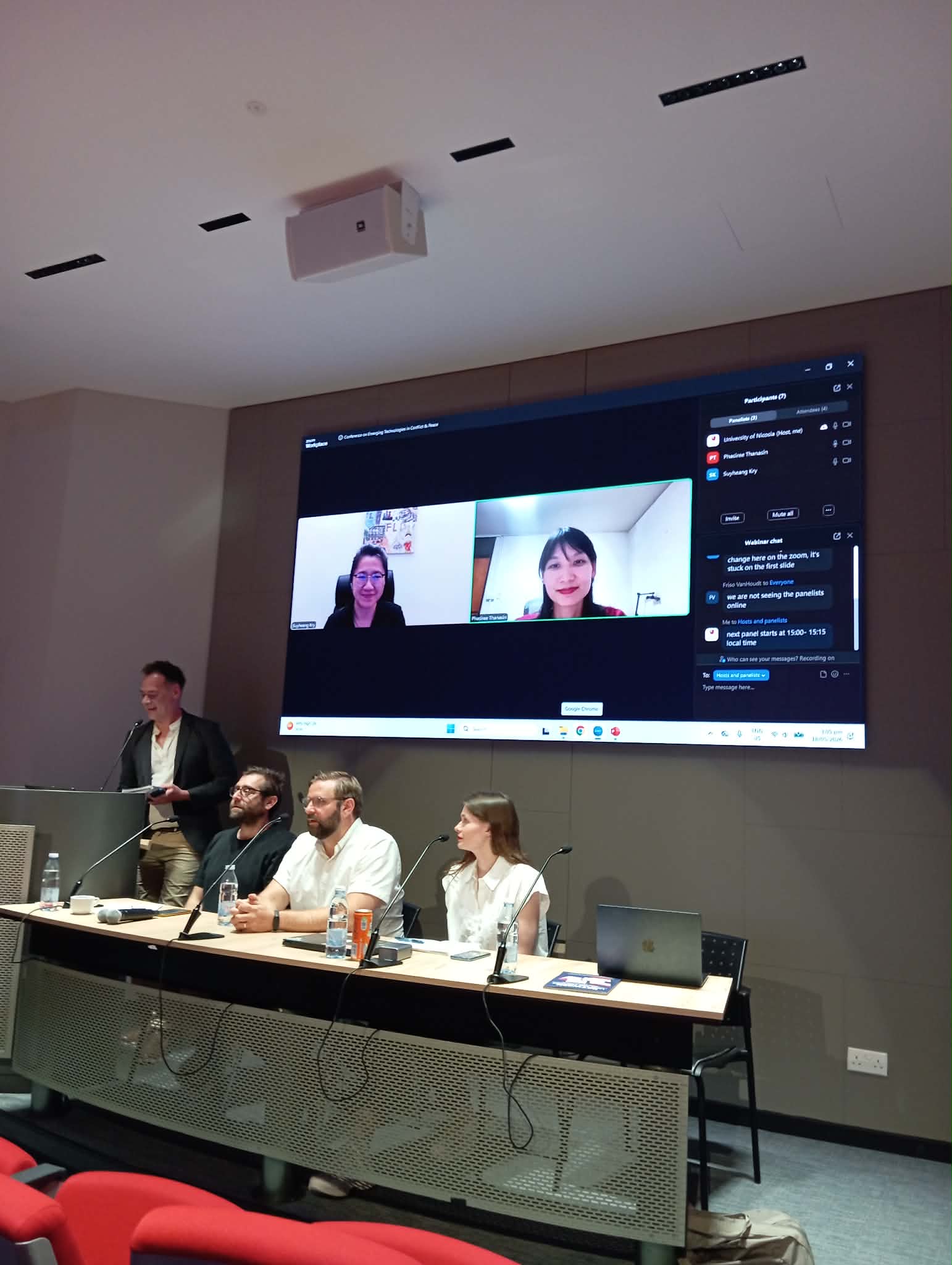
EuroMemo Group Conference 2026
10–12 September 2026 | Oxford Brookes University, Oxford, United Kingdom
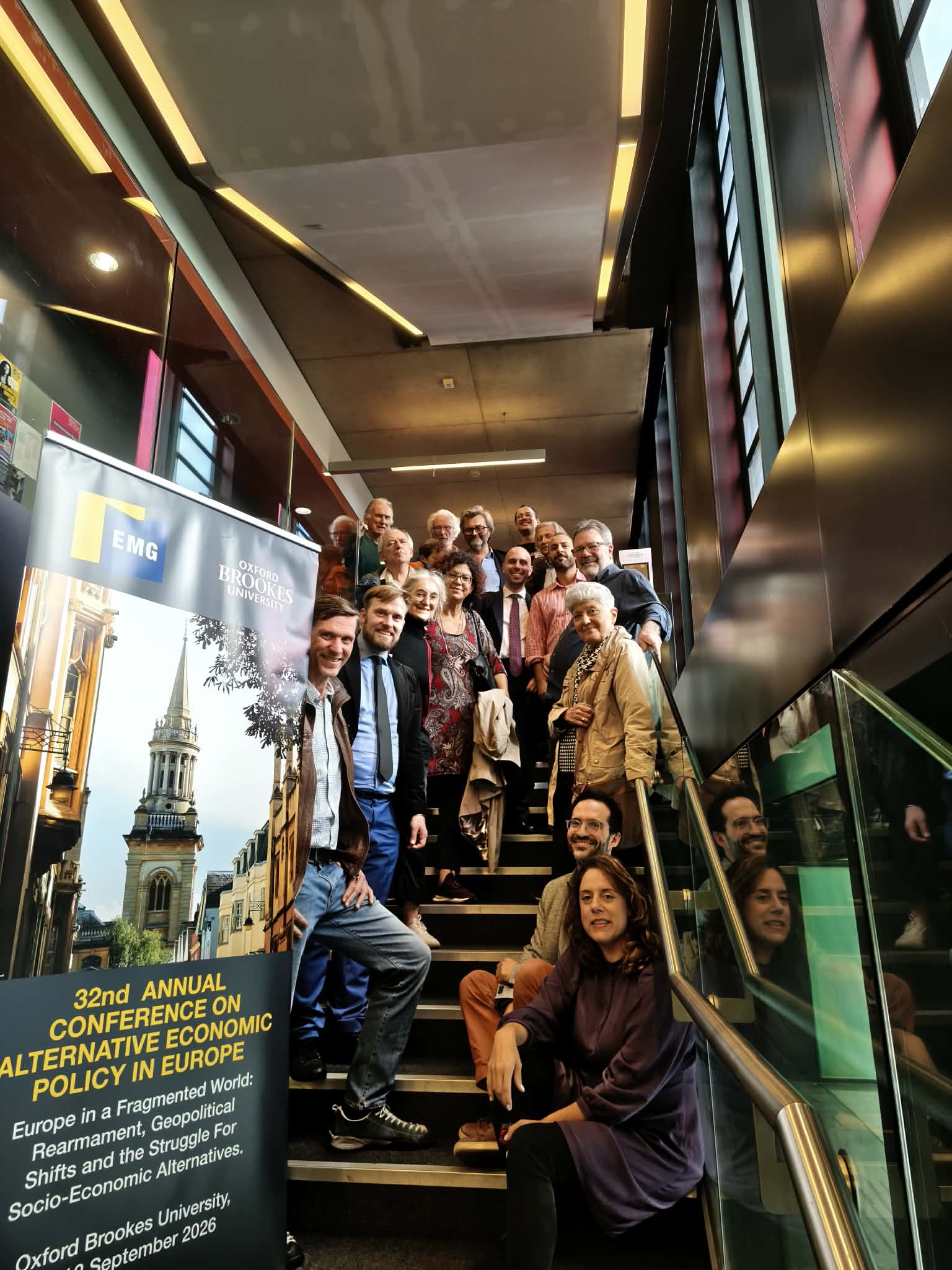
The first day of the EuroMemo Group Conference brought together critical economists, political economists, sociologists, and researchers of corporate power to examine Europe’s position in a fragmented global order. Across two panels, speakers explored the transformation of the international economic system, the relationship between financialization and militarization, the growing influence of corporate actors, and the need to develop socio-economic alternatives centred on social welfare, democratic accountability, and human needs. The discussions were introduced and chaired by Anne Eydoux of the Conservatoire National des Arts et Métiers in Paris. Her introductory remarks situated the conference within the broader challenges posed by geopolitical fragmentation, rearmament, and the search for alternative economic and political strategies.


Panel I: Europe’s Geoeconomic Position and the Crisis of the Washington Consensus
Gary Dymski, Professor of Applied Economics at the University of Leeds, opened the substantive discussion with his presentation, “The Geopolitical State of Europe: From Washington Consensus to Geoeconomic Triangle of Power?” His contribution examined the transformation of the global economic order and the consequences of the United States’ changing approach to multilateralism. Dymski argued that the United States has increasingly abandoned responsibility for completing and consolidating the World Trade Organization as a genuinely fair and open multilateral trading system. Instead, particularly since the emergence of the North American Free Trade Agreement in 1992, US trade policy has increasingly relied on bilateral and trilateral arrangements designed to secure national economic advantages. In this context, Wall Street has benefited from persistent current-account deficits, while the US economy has continued to sustain patterns of accumulation based on living beyond its means. A central argument was that the United States itself has repeatedly violated the principles associated with the Washington Consensus. Rather than representing a consistent framework of market discipline and economic governance, the system has been applied selectively and strategically. Dymski’s analysis thus pointed towards a fragmented form of accumulation and a changing distribution of global economic power. The question of whether Europe is moving towards a new geoeconomic triangle of power was raised against this background of declining multilateral coherence and intensifying geopolitical competition.
Dany Lang, Associate Professor at Sorbonne Paris, followed with the presentation “What Counts is Everything but Wages and Climate.” His contribution focused on European economic governance, fiscal priorities, and the growing influence of security considerations on economic policy. Lang highlighted the availability of European budgetary resources for defence purposes and discussed the European Semester’s Spring Package of 3 June 2026, particularly the Commission’s proposal to extend the existing flexibility framework to measures related to energy security. Against the backdrop of the energy crisis and the geopolitical consequences of the war in Iran, energy security has increasingly become a central issue in European economic policy. At the same time, Lang emphasized France’s commitment to significant austerity. His contribution raised questions about the priorities embedded in contemporary European economic governance: while defence and security expenditures can receive increasing political attention and fiscal flexibility, wages, climate protection, and social needs risk being treated as secondary concerns. The title of his presentation captured this tension between the stated priorities of economic policy and the material conditions of people’s lives.
The first panel concluded with Susan Murphy, Associate Professor in Development Practice and Fellow of Trinity College Dublin. Her contribution emphasized the importance of care, community, and connections as foundations for an alternative approach to socio-economic development. Murphy connected the crises discussed by the previous speakers to the erosion of institutions and social relationships under the Washington Consensus. She argued that institutions must be revitalized and that politics and policy-making need to be more closely connected to the everyday needs of people. This requires not only better regulations, but also practices that bring political decision-making closer to communities and social realities. Her intervention shifted the discussion from the diagnosis of systemic crisis towards the question of how institutions can be reconstructed. By placing care, community, and connections at the centre, Murphy proposed a perspective in which economic and political alternatives are evaluated not merely through growth or competitiveness, but through their capacity to support social life and collective well-being.
Panel II: Corporate Power, Financialization, Militarization, and Subimperialism
The second panel was chaired by Claudio Cozza and focused more directly on the relationship between economic power, corporate influence, militarization, and global political structures.
Cecilia Rikap, Associate Professor in Economics at University College London, examined the growing power of large technology corporations. Her analysis centred on what she described as a form of “epistemic totalitarianism”: the capacity of major technology companies not only to shape markets and infrastructures, but also to influence what governments think about artificial intelligence and technology, including what should or should not be regulated. Rikap highlighted the growing concentration of power in energy, infrastructure, cloud computing, data centres, and artificial intelligence. These interconnected sectors form what she characterized as a predatory ecosystem, in which corporate control extends beyond individual products or services to the infrastructures upon which societies and states increasingly depend. Her contribution raised fundamental questions about democratic sovereignty. If corporations possess the capacity to shape the knowledge, technological systems, and policy frameworks through which governments make decisions, then corporate power becomes not merely an economic issue but also a political and epistemic one.
Francesco Saraceno, Deputy Department Director at the Observatoire français des conjonctures économiques (OFCE), addressed the connections between financialization, deregulation, and militarization. His contribution examined how the transformation of economic governance is linked to the growing prominence of security and military priorities. The presentation suggested that militarization should not be understood as an isolated development in defence policy. Rather, it is connected to broader processes of deregulation and financialization that have reshaped the relationship between markets, states, and public resources. The discussion therefore reinforced one of the conference’s central concerns: the need to understand rearmament within the wider political economy of contemporary capitalism.
Patrick Bond, Professor of Sociology at the University of Johannesburg, turned to the global political economy of the BRICS. Drawing on the writings of Rosa Luxemburg, David Harvey, Dani Nabudere, and Ruy Mauro Marini, he examined whether the BRICS should be understood as an anti-imperialist alternative to Western dominance or rather as a form of subimperialism. Bond’s analysis challenged simplified interpretations of the BRICS as a unified counterweight to the existing international order. Drawing on Immanuel Wallerstein’s world-systems perspective, he noted that the incorporation of countries from the former periphery into BRICS structures reflects important shifts in the global distribution of power. Yet these developments also contain internal contradictions and competing interests. The BRICS, in this reading, cannot be treated as a homogeneous bloc. Their members occupy different positions within the global economy, and their political and economic projects may reproduce certain hierarchical and imperial relationships even while challenging Western dominance. Bond’s contribution therefore encouraged a more differentiated analysis of multipolarity, one that recognizes both its emancipatory potential and its internal power asymmetries.
The final speaker, Vicky Cann, researcher at Corporate Europe Observatory, focused on the role of corporate lobbying in European decision-making. She emphasized that the European Union is the world’s second-largest lobbying environment after the United States and that corporate actors exercise enormous influence over policy-making. Cann argued that corporate lobbyists have left their fingerprints on European laws and regulations. Her contribution highlighted the importance of examining the institutional mechanisms through which private interests shape public policy. In this context, the question of democratic accountability becomes inseparable from the question of who has access to decision-makers, who shapes legislative processes, and whose interests are ultimately reflected in European regulation.
Main Key Takeaways
- The Washington Consensus is in crisis, but its consequences remain deeply embedded. The first panel highlighted how the international economic order has become increasingly fragmented, while the principles of the Washington Consensus have been applied selectively and inconsistently.
- Europe’s strategic and economic position must be understood within a changing global power structure.
The discussion of a possible geoeconomic triangle of power pointed to the need to reassess Europe’s role amid declining multilateral coherence and intensifying geopolitical competition. - Rearmament and security policy are increasingly shaping economic governance.
Defence and energy security are receiving growing fiscal and political attention, raising questions about the balance between military priorities, social expenditure, and climate protection. - Financialization, deregulation, and militarization are interconnected processes.
Militarization should not be analysed in isolation from the broader political economy of contemporary capitalism. - Corporate power is also epistemic and infrastructural.
The influence of large technology corporations extends beyond markets to the infrastructures, knowledge systems, and regulatory frameworks through which governments make decisions. - Multipolarity does not automatically mean emancipation.
The BRICS may challenge Western dominance while simultaneously reproducing internal hierarchies and forms of subimperialism. A critical analysis must therefore account for contradictions within emerging power centres. - Democratic accountability requires confronting corporate lobbying.
The influence of corporate actors on European legislation demonstrates the importance of examining who shapes policy and whose interests are represented. - Socio-economic alternatives must begin with human needs.
Susan Murphy’s emphasis on care, community, and connections offered a constructive counterpoint to the dominant focus on competitiveness, security, and accumulation.
Institutions need to be revitalized and reconnected with society.
A recurring theme was the need to bring politics and policy-making closer to the everyday realities and needs of people.
The central challenge is to connect geopolitical analysis with socio-economic transformation.
The first day demonstrated that Europe’s response to fragmentation, rearmament, and geopolitical change cannot be reduced to questions of strategic power alone. It also requires a democratic and socially grounded vision of economic governance.
Second Day:
The first panel examined the transformation of the international order, the relationship between strategic autonomy and resource security, and the implications of German militarization. The second panel continued these discussions by addressing the European Union’s strategic autonomy, the political economy of war and peace, and possible pathways toward a renewed peace architecture.
From Bipolarity to a New International Order: Jacques Mazier and Pascal Petit
Jacques Mazier and Pascal Petit from the Université Sorbonne in Paris examined the transformation of the international system from the bipolar order of the Cold War to the unipolar order dominated by the United States following the collapse of the Soviet Union. Their contribution situated the present moment within a broader historical transformation. The dominance of the unipolar order is increasingly being challenged by the emergence of a more fragmented and multipolar international system. The speakers interpreted this development as a possible turning point and argued for a revival of multilateralism rather than a renewed politics of military blocs and geopolitical confrontation. Particular emphasis was placed on the need to strengthen human rights, welfare-state institutions, and social protections. From this perspective, Europe’s resilience and international role should not be reduced to military capabilities or defence expenditure. Democratic and social institutions are equally important foundations of political stability and international cooperation. A particularly significant argument concerned the future of European security. Rather than pursuing a European defence project centred primarily on military power, Mazier and Petit pointed toward non-alignment as a possible alternative. Such an approach could provide greater strategic independence while avoiding the reproduction of bloc confrontation and contributing to a more cooperative international order.
De-Risking versus Strategic Autonomy: Airos Ioannis Papadopoulos
Airos Ioannis Papadopoulos from the ENA Institute for Alternative Policies focused on the relationship between de-risking and strategic autonomy. His presentation highlighted the increasing securitization of economic and political life. Areas such as trade, technology, energy, infrastructure, and access to raw materials are increasingly interpreted through the lens of strategic competition and security. This development raises important questions about the consequences of securitization. When economic relations are primarily understood as security concerns, economic policy risks becoming subordinated to geopolitical rivalry. De-risking may therefore reduce certain dependencies while simultaneously reinforcing a competitive international environment. Papadopoulos also emphasized that Europe is not the only region pursuing strategic autonomy. India and Latin America are developing their own approaches to economic sovereignty and strategic independence. This broader perspective challenges the assumption that strategic autonomy is exclusively a European project. Particular attention was given to green hydrogen and lithium, which are becoming increasingly important in the context of Europe’s ecological and technological transformation. Europe’s green transition creates new dependencies on critical raw materials and energy resources, making external partnerships and initiatives such as the EU’s Global Gateway increasingly significant. The discussion of the Lithium Triangle (Argentina, Bolivia, and Chile) was especially relevant. The region contains a substantial share of the world’s known lithium resources, making it economically important for the global energy transition and potentially strengthening the bargaining position of Latin American states pursuing their own forms of strategic autonomy. The presentation therefore raised a fundamental question: Can strategic autonomy become a genuinely reciprocal concept, allowing different regions to strengthen their economic sovereignty, or does European de-risking risk reproducing asymmetrical relationships between Europe and resource-rich countries?
German Militarization and Industrial Policy: Judith Dellheim
Dr. Judith Dellheim from the Rosa-Luxemburg-Stiftung addressed the transformation of German industrial and economic policy in the context of increasing militarization. She highlighted the growing role of military expenditure and the restructuring of Germany’s defence capabilities. One example discussed was the establishment of the 45th Bundeswehr Armoured Brigade “Lithuania,” planned to reach approximately 5,000 soldiers. This development illustrates Germany’s increasing military presence on NATO’s eastern flank and its broader commitment to European defence. Dellheim connected military expansion to wider processes of economic restructuring. Her analysis suggested that the emerging German model risks combining increased military expenditure with austerity-oriented economic policies. From this perspective, the idea of a stronger German role in Europe may produce a particular vision of a “German Europe,” in which military expansion and industrial policy become closely interconnected. A central concern was the potential opportunity cost of rearmament. Resources directed toward military expansion may come at the expense of social expenditure, welfare institutions, and investments required for a socially and ecologically sustainable transformation. Dellheim also emphasized the importance of taking climate considerations seriously. She argued that growing militarization risks moving Germany further away from the objectives of the Paris Agreement on Climate Change. In this context, she made a strong case for closer cooperation between the climate movement and the peace movement, emphasizing that ecological sustainability and peace should not be treated as separate political objectives.
European Union Strategic Autonomy between Sovereignty and Imperial Reproduction: Josef Mühlbauer
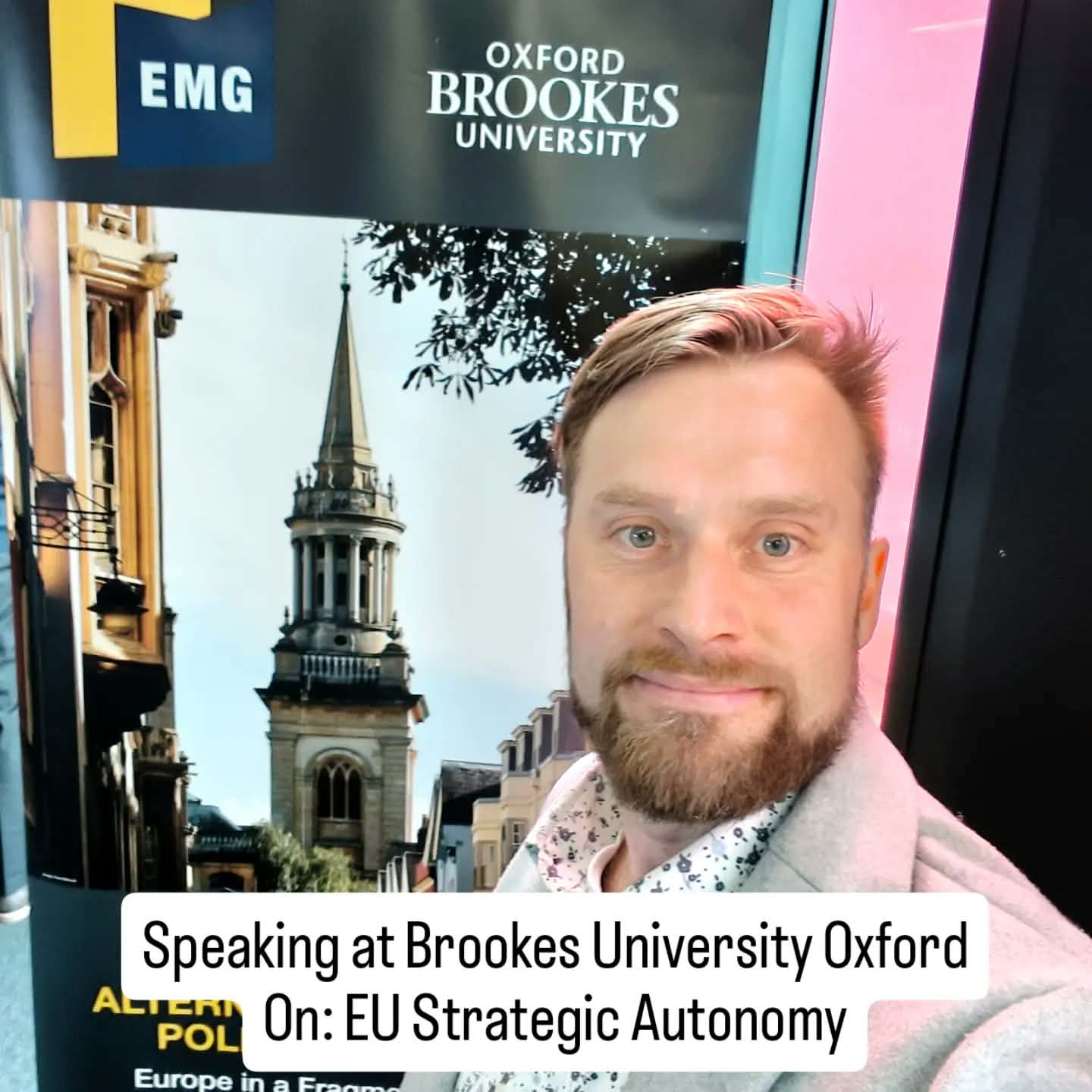
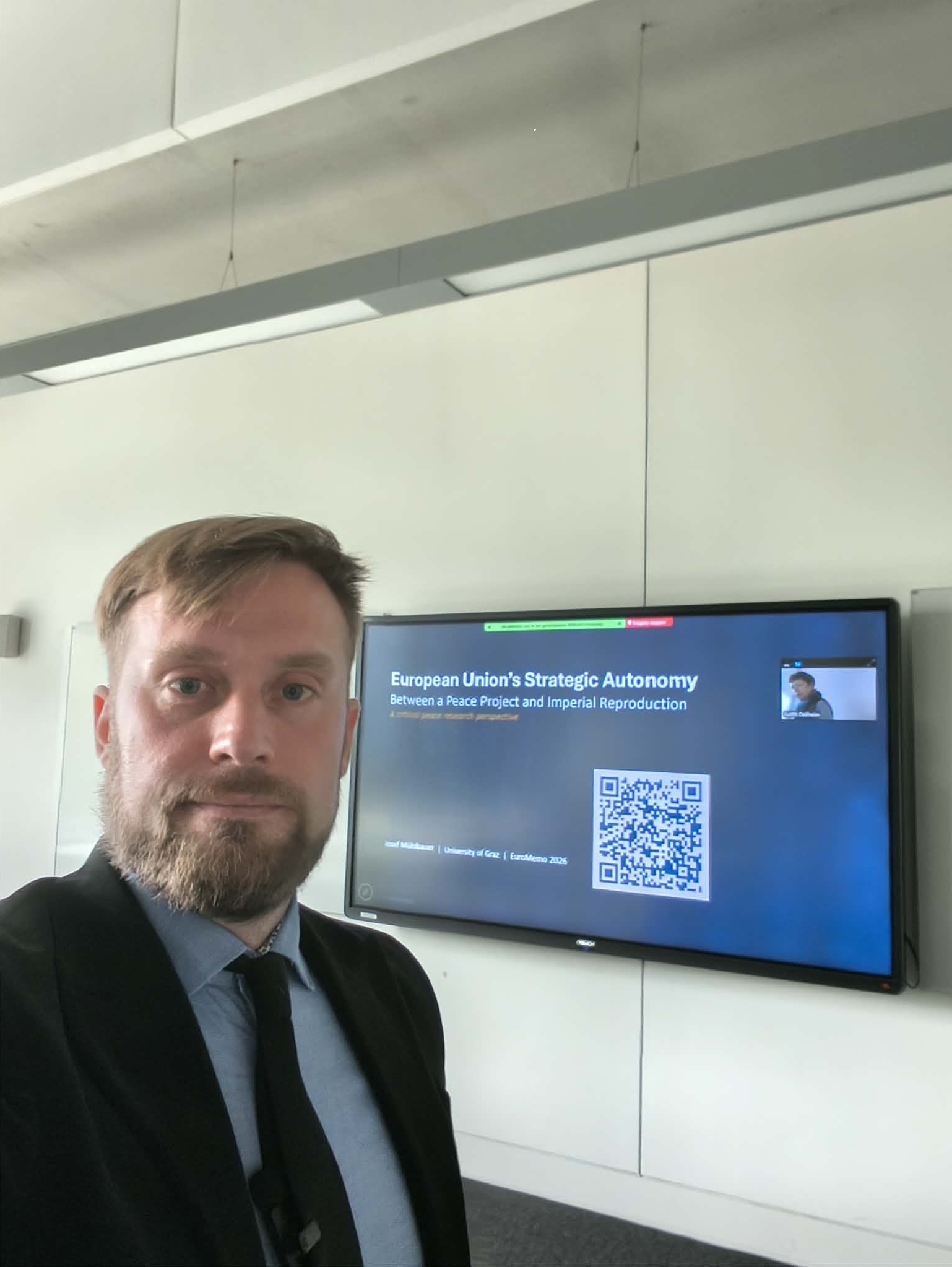
Peace and Conflict Researcher Josef Mühlbauer from the University of Graz presented his paper, “European Union Strategic Autonomy between Sovereignty and Imperial Reproduction.” Mühlbauer argued that the European Union’s pursuit of strategic autonomy is fundamentally shaped by the contemporary polycrisis, the return of inter-state war to Europe, and the erosion of the Pax Americana. Strategic autonomy should therefore be understood not merely as a geopolitical strategy, but also as a response to structural vulnerabilities and dependencies exposed by these transformations. At the same time, the presentation emphasized the concept’s dual genealogy. Strategic autonomy contains emancipatory and peace-oriented dimensions, particularly insofar as it can strengthen political sovereignty and reduce external dependencies. However, it is also embedded in historical practices and imaginaries of European colonialism and imperial power. The concept must therefore be examined critically in relation to the possibility of reproducing unequal global relations. Mühlbauer developed five policy recommendations for translating strategic autonomy into a European peace project. These recommendations seek to reorient the concept away from a predominantly geopolitical and security-centred paradigm toward one grounded in peace, multilateralism, democratic sovereignty, and global justice. A particularly important point was the need for a new security and peace architecture. In this context, the Helsinki Final Act of 1975 was highlighted as a historical reference for developing principles of cooperative security, territorial integrity, and the indivisibility of security. Strategic autonomy, from this perspective, should not be equated with military self-reliance or the creation of new spheres of influence. Rather, it should contribute to a more inclusive and cooperative international order.
The Political Economy of War and Peace: Anton Filipenko
Anton Filipenko from Taras Shevchenko National University of Kyiv presented on “The Political Economy of War and Peace.” His contribution examined the economic consequences of war and the relationship between international political economy and geopolitical conflict. According to the presentation, the Russian invasion of Ukraine in 2022 had severe consequences for global economic growth and particularly destabilized countries in the Global South. Food insecurity, shortages of fertilizers, and disruptions to global economic relations were identified as important dimensions of this wider shock, with African states among those particularly affected. Filipenko situated the contemporary discussion within a longer history of armed conflict, noting that approximately 250 wars and armed conflicts have been recorded since the Second World War. He also referred to Niccolò Machiavelli’s argument that free republics are not necessarily peaceful, but may represent particularly effective forms of expansion. In this reading, imperial expansion can be understood as a strategy associated with state survival—a perspective Filipenko connected to contemporary Russia. The presentation also distinguished between three broad doctrines of international political economy:
- Liberalism, associated in the presentation with the European Union;
- Realism, associated with the United States;
- Marxism, associated with China.
Against the logic of military competition, Filipenko referred to Immanuel Kant’s concept of perpetual peace. Kant’s critique of rulers prepared to use any means to strengthen the military power of the state provided a normative foundation for considering alternative approaches to international security. One of the hypothetical scenarios discussed involved the prohibition of nuclear weapons, reductions in conventional armaments, and the establishment of a modern peacekeeping force under the umbrella of the United Nations. In such a scenario, military alliances, including NATO, would no longer be necessary, while conflict resolution would rest primarily with UN peacekeeping institutions. Filipenko also proposed alternative diplomatic approaches to the Russian-Ukrainian war. He argued that previous agreements, including the Minsk Agreements and the Istanbul negotiations, had failed to produce a lasting settlement and that Track 1 diplomacy had reached a deadlock. To overcome this impasse, he proposed the creation of an international network of think tanks and research institutions—including EuroMemo and SIPRI—to develop recommendations for both sides of the conflict. A second proposal involved a Track 1.5 initiative, bringing together representatives of civil society, academics, non-governmental organizations, churches, and other relevant actors. Such an approach would broaden the diplomatic process beyond official state representatives and create additional channels for dialogue, conflict analysis, and peacebuilding. These proposals reflect the broader concern expressed throughout the conference that international conflicts require more than military responses and that alternative diplomatic and societal actors can contribute to overcoming entrenched political deadlocks.
Conclusion
The second day of the Oxford conference demonstrated the close relationship between international political economy, strategic autonomy, militarization, and peace. Although the presentations approached these issues from different perspectives, several common themes emerged.
First, the international system is undergoing a significant transformation from the post-Cold War unipolar order toward a more fragmented and potentially multipolar configuration. Second, Europe’s response to this transformation is increasingly shaped by securitization, military expansion, and de-risking. Third, these developments raise questions about the social, ecological, and global consequences of current economic and security policies.
The presentations also emphasized that strategic autonomy is a contested concept. It may provide opportunities for greater sovereignty and independence, but it can also reproduce asymmetrical relationships and imperial patterns if it remains embedded in competitive geopolitical strategies.
Finally, the conference highlighted the importance of alternative approaches based on multilateralism, non-alignment, democratic sovereignty, social welfare, ecological sustainability, and international cooperation. The reference to the Helsinki Final Act, Kantian perpetual peace, alternative diplomatic tracks, and cooperation between peace and climate movements pointed toward a broader understanding of security—one that moves beyond military capabilities and seeks to establish a more inclusive and sustainable peace architecture.