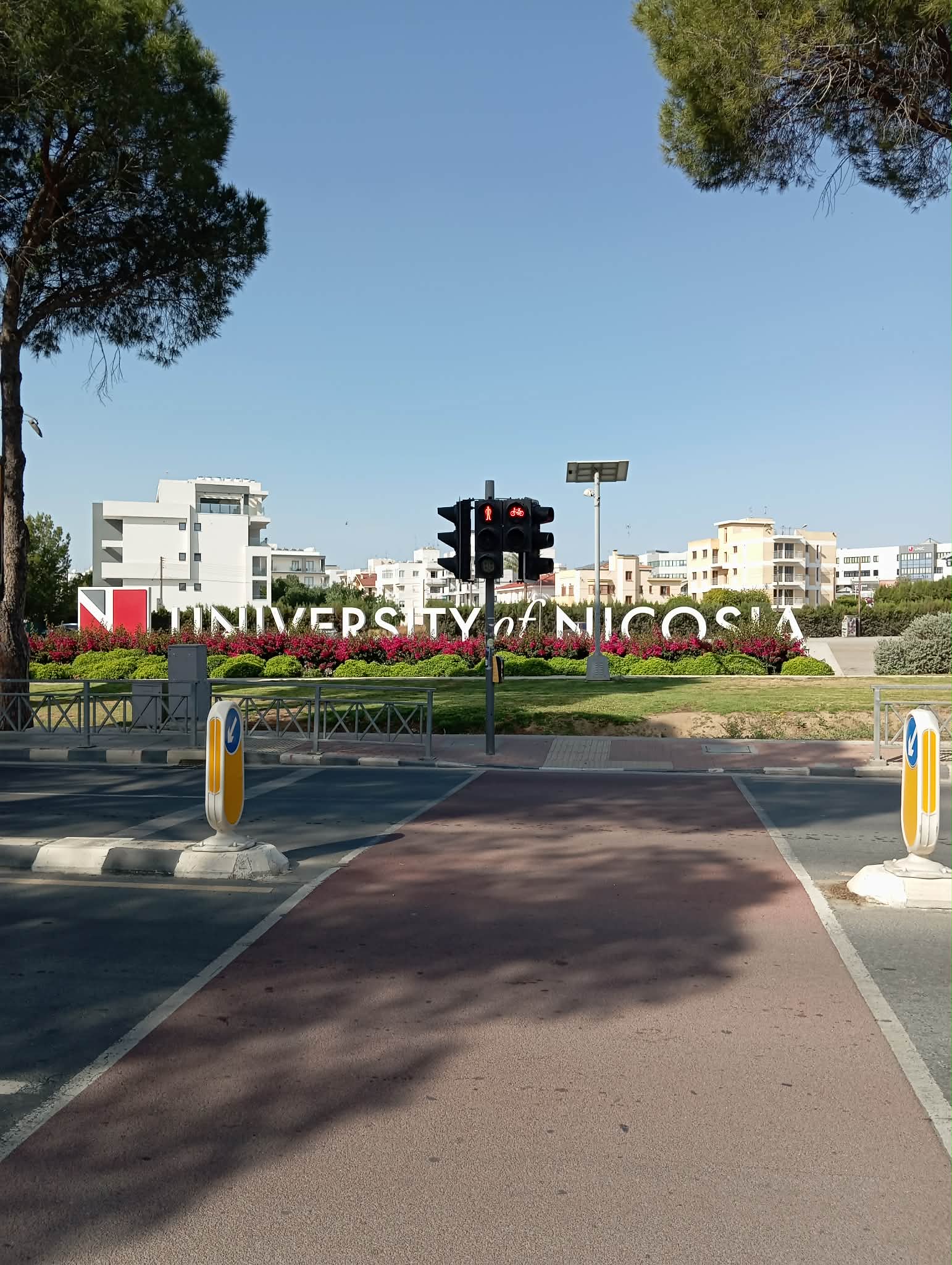
Day 1, Critical Peace Research Conference at the University of Nicosia
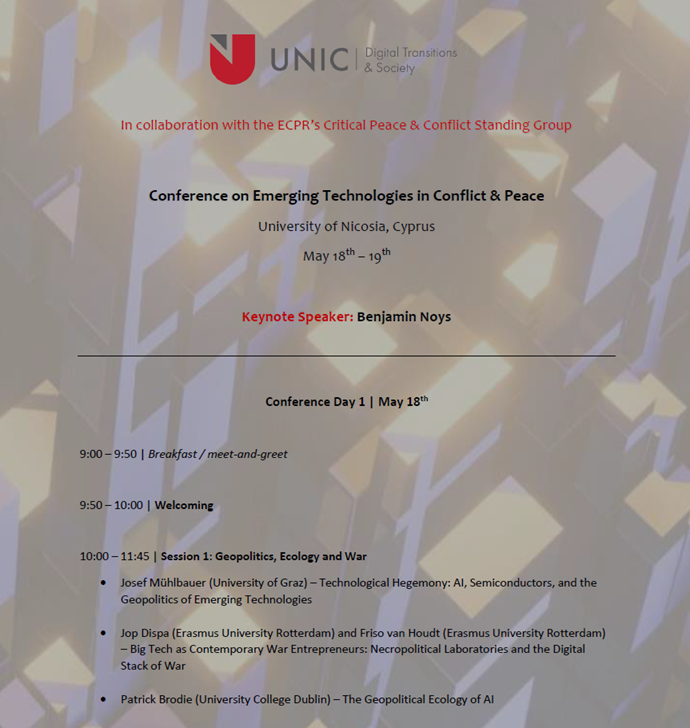
The first day of the international conference on Emerging Technologies in Peace & Conflict, jointly organized by the Critical Peace Research Standing Group and the University of Nicosia, brought together scholars from political science, peace and conflict studies, media studies, sociology, and critical technology studies. The conference examined how emerging technologies—particularly artificial intelligence (AI), digital platforms, biometric identification, and surveillance systems—are reshaping global power relations, war, governance, labour, migration, and identity.
In his opening remarks, Michaelangelo Anastasiou (University of Nicosia) emphasized that technologies are never neutral tools. Rather, they reflect and reinforce existing power structures and are deeply embedded in questions of hegemony, peace, and conflict. Emerging technologies, he argued, must therefore be analyzed politically and critically, not simply as technical innovations.
The day was organized into four thematic sessions: Geopolitics, Ecology and War; Identity, Politics and Governance; Conflict and Crisis; and Borders, Space and Migration. Across all panels, a common thread emerged: digital technologies increasingly function as infrastructures of power, enabling new forms of domination while also creating new terrains of contestation.
Session I: Geopolitics, Ecology and War
Technological Hegemony: AI, Semiconductors and the Geopolitics of Emerging Technologies
Josef Mühlbauer (University of Graz)
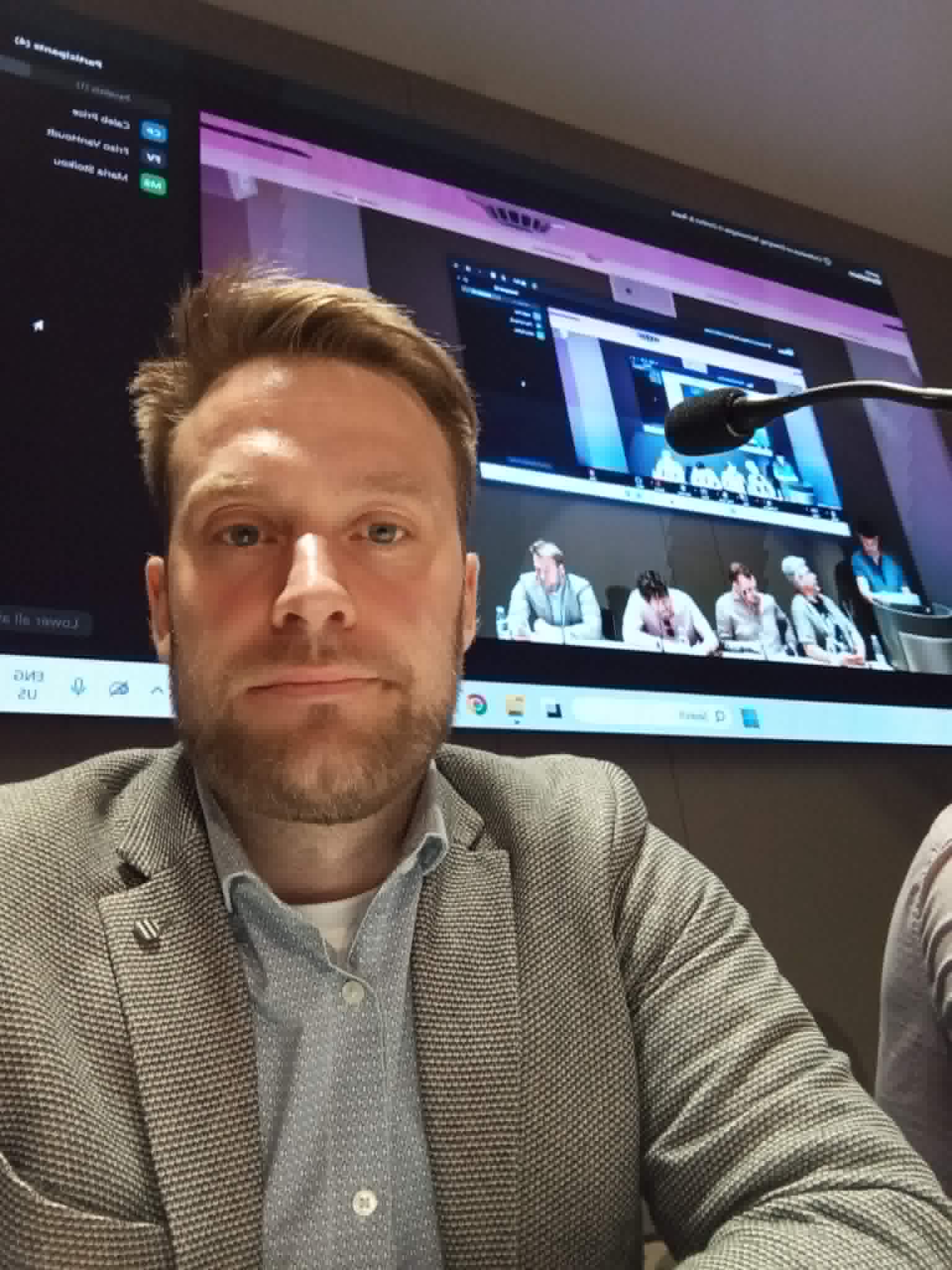
Peace Researcher Josef Mühlbauer opened the conference’s first panel with a presentation examining artificial intelligence and emerging technologies as central arenas in the hegemonic competition between the United States and China. His presentation focused on the strategic importance of semiconductor production, control over supply chains, and the geopolitical implications of technological dependence.
The argument emphasized that technological development cannot be understood independently from global political economy. AI, semiconductors, and digital infrastructures have become essential sources of economic and military power. The competition over these technologies is therefore shaping a new phase of geopolitical rivalry and reconfiguring global governance structures.
Big Tech as Contemporary War Entrepreneurs: Necropolitical Laboratories and the Digital Stack of War
Jop Dispa and Friso van Houdt (Erasmus University Rotterdam)
Jop Dispa presented a striking critique of the relationship between Big Tech and contemporary warfare, drawing on the concepts of necropolitics, racial capitalism, and algorithmic governmentality. The presentation focused particularly on the use of digital technologies in the Israeli war in Gaza.
Dispa argued that large technology corporations—including Amazon, Google, and Palantir Technologies—have become integral actors in modern warfare. Through projects such as Project Nimbus, cloud computing infrastructures and data storage services are directly linked to military operations and systems of occupation. Central to the presentation was the notion of the “digital stack of war,” an assemblage of state institutions, private corporations, and academic knowledge producers. This configuration resembles a “triple helix” of security and innovation, where responsibility for the use of technology becomes diffused among multiple actors. Dispa highlighted AI-based systems reportedly used by the Israeli military, including Lavender (algorithmic target profiling), Gospel (infrastructure strike selection), and Where’s Daddy (location tracking of individuals). These systems dramatically accelerate the “kill chain,” shortening the time between surveillance, identification, and lethal action. The presentation described the occupied Palestinian territories as “necropolitical laboratories” where new technologies are tested on populations deemed disposable. Each cycle of surveillance and violence generates new data, which in turn improves subsequent technologies, creating a cybernetic feedback loop that intensifies conflict. Dispa also drew parallels with domestic surveillance systems in the United States, particularly within agencies such as ICE and DHS, demonstrating how technologies developed in war zones can later be applied in border enforcement and migration control.
The Geopolitical Ecology of AI
Patrick Brodie (University College Dublin)
Patrick Brodie offered a political-economic and ecological analysis of artificial intelligence, drawing on world-systems theory and dependency theory. He argued that AI should be understood not merely as software but as a vast material infrastructure requiring minerals, energy, data centres, and highly concentrated cloud services.
Brodie emphasized that three major corporations dominate roughly three quarters of the global infrastructure-as-a-service market, creating unprecedented dependencies. He explored the case of Ireland as a strategic site of AI development, hosting major data centres, semiconductor production facilities such as Intel Corporation, and rapidly expanding energy infrastructure. The growth of data centres has transformed Irish industrial policy and even revived debates about nuclear energy to meet escalating electricity demands. Brodie characterized this process as the militarization of foreign direct investment, arguing that states can become embedded in geopolitical conflicts through their role in hosting digital infrastructures. Despite Ireland’s formal military neutrality and strong public solidarity with Palestine, the country’s integration into U.S.-dominated technological networks demonstrates how economic dependence can constrain political autonomy.
Session II: Identity, Politics and Governance
Emerging Technologies as Dispositifs of Delegated Governance
Shirin Arianna Reza Elahi (University of Sussex and Università del Piemonte Orientale)
Shirin Arianna Reza Elahi explored how emerging technologies mediate care, governance, and subjectivity, particularly in relation to queer and neurodivergent communities. Drawing on Michel Foucault and James C. Scott, she conceptualized AI as part of a broader “psycho-algorithmic dispositive.”
Her argument suggested that psychiatric disciplines, Big Data, and AI systems increasingly work together to classify individuals according to norms of order and deviance. Those who do not conform to standardized behavioural expectations are often framed as risky, noisy, or dangerous. These developments contribute to what she termed “psyche regimes,” in which algorithmic systems subtly shape self-understanding and social participation. The broader democratic concern lies in the quiet expansion of administrative and diagnostic power over marginalized populations.
Digital Passing in the Era of Biometric Identification
Beata Paragi (Corvinus University of Budapest)
Beata Paragi examined the implications of biometric identification technologies for migrants, refugees, and other vulnerable populations. Her presentation connected critical migration studies, surveillance studies, and political theory to analyze how digital systems redefine identity, citizenship, and rights.
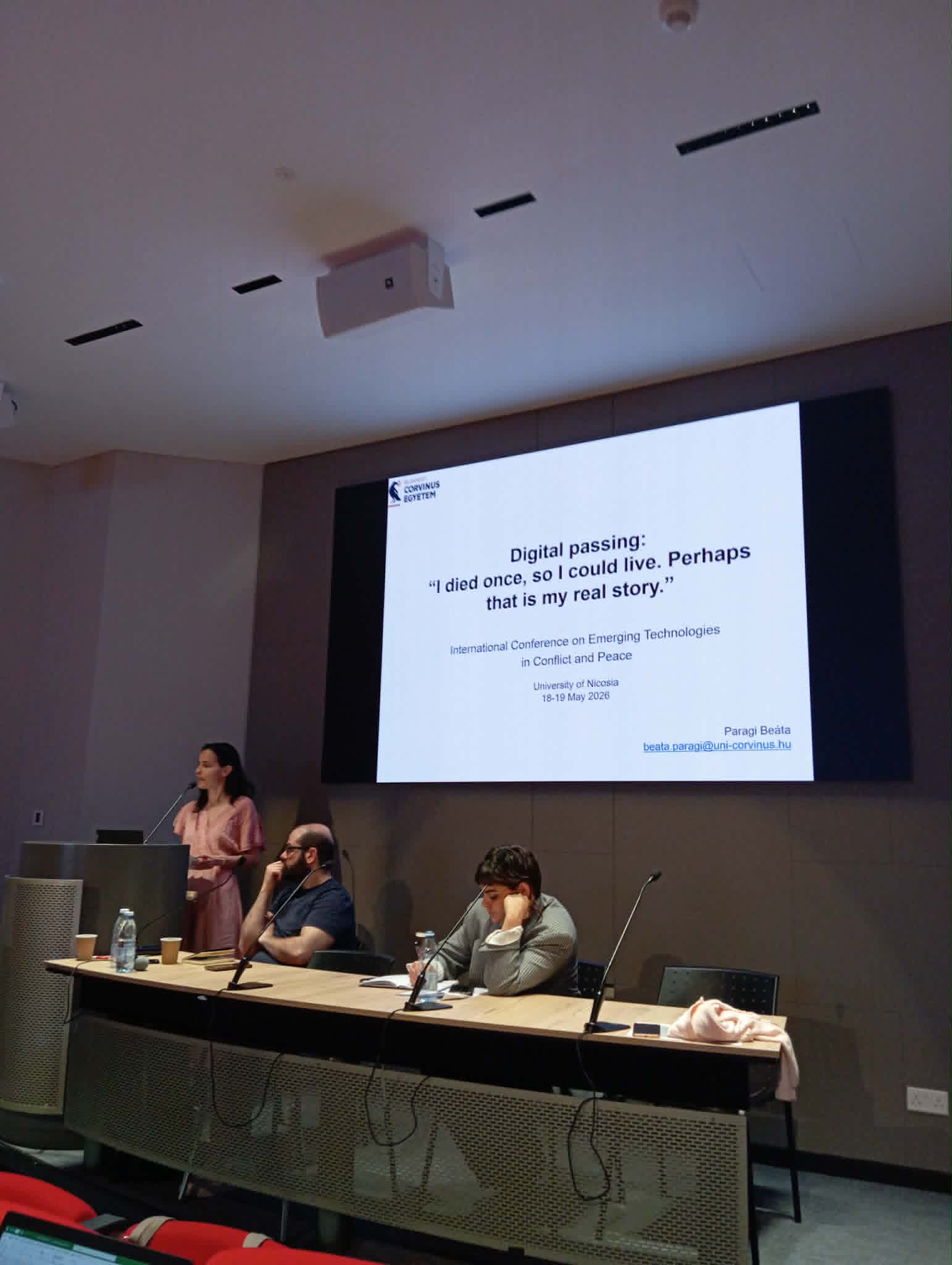
Building on Paul Ricoeur, she distinguished between identity as sameness (idem) and identity as selfhood (ipse). This distinction highlights the tension between state-imposed categorizations and individuals’ narrative understandings of themselves. Paragi introduced the concept of “digital passing,” inspired by scholarship on assumed identities during the Holocaust. In the contemporary context, individuals may seek to navigate or resist digital systems that objectify bodies and reduce persons to biometric data points. Her presentation underscored how emerging technologies can deepen exclusion by blurring the boundaries between immigration control, criminal law, and humanitarian governance.
Session III: Conflict and Crisis
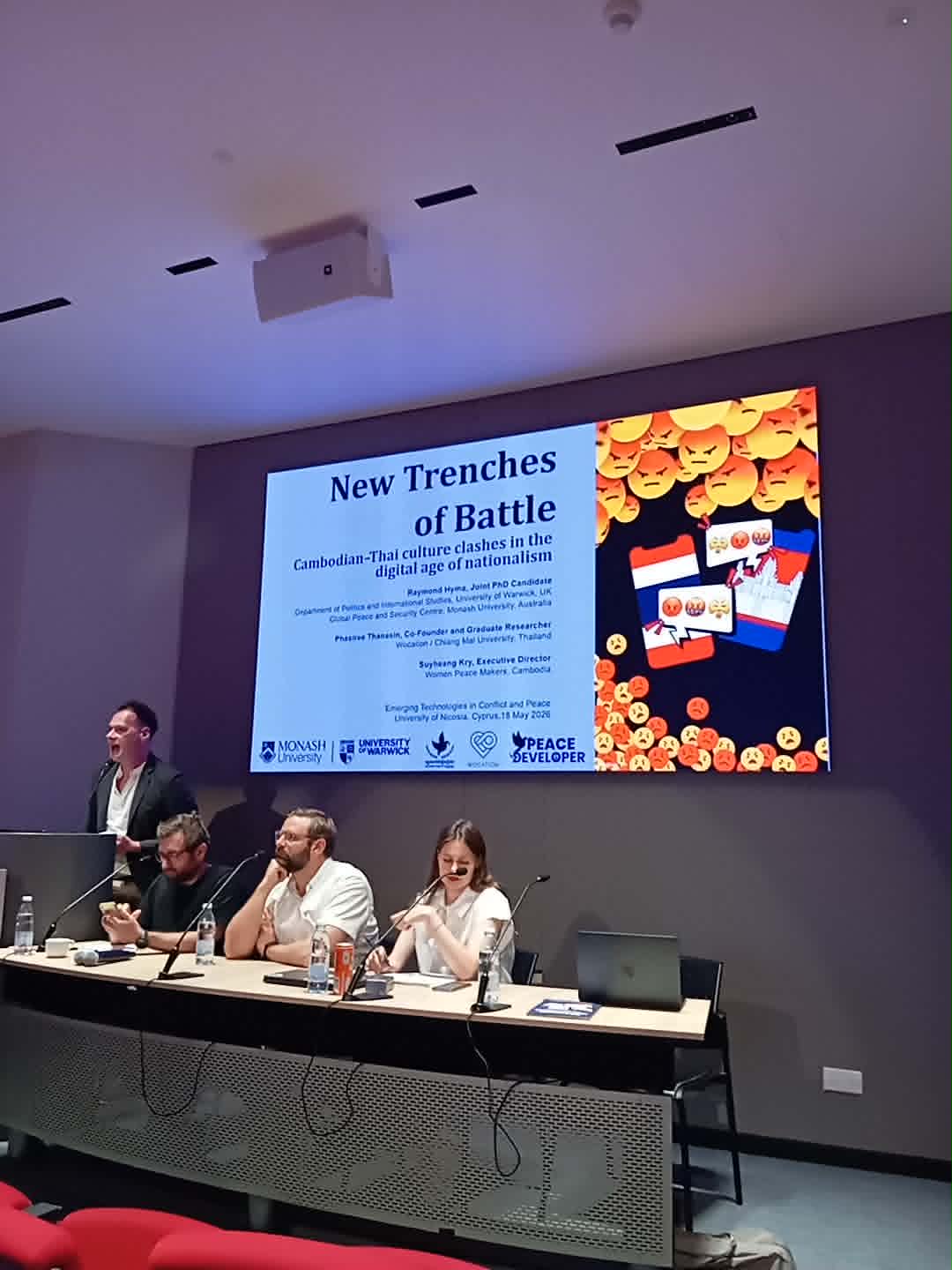
New Trenches of Battle: Cambodian–Thai Culture Clashes in the Digital Age of Nationalism
Raymond Hyma (University of Warwick)
Raymond Hyma presented research on digital nationalism in the context of the long-standing tensions between Cambodia and Thailand. His analysis focused on how social media platforms amplify nationalist narratives and historical grievances.
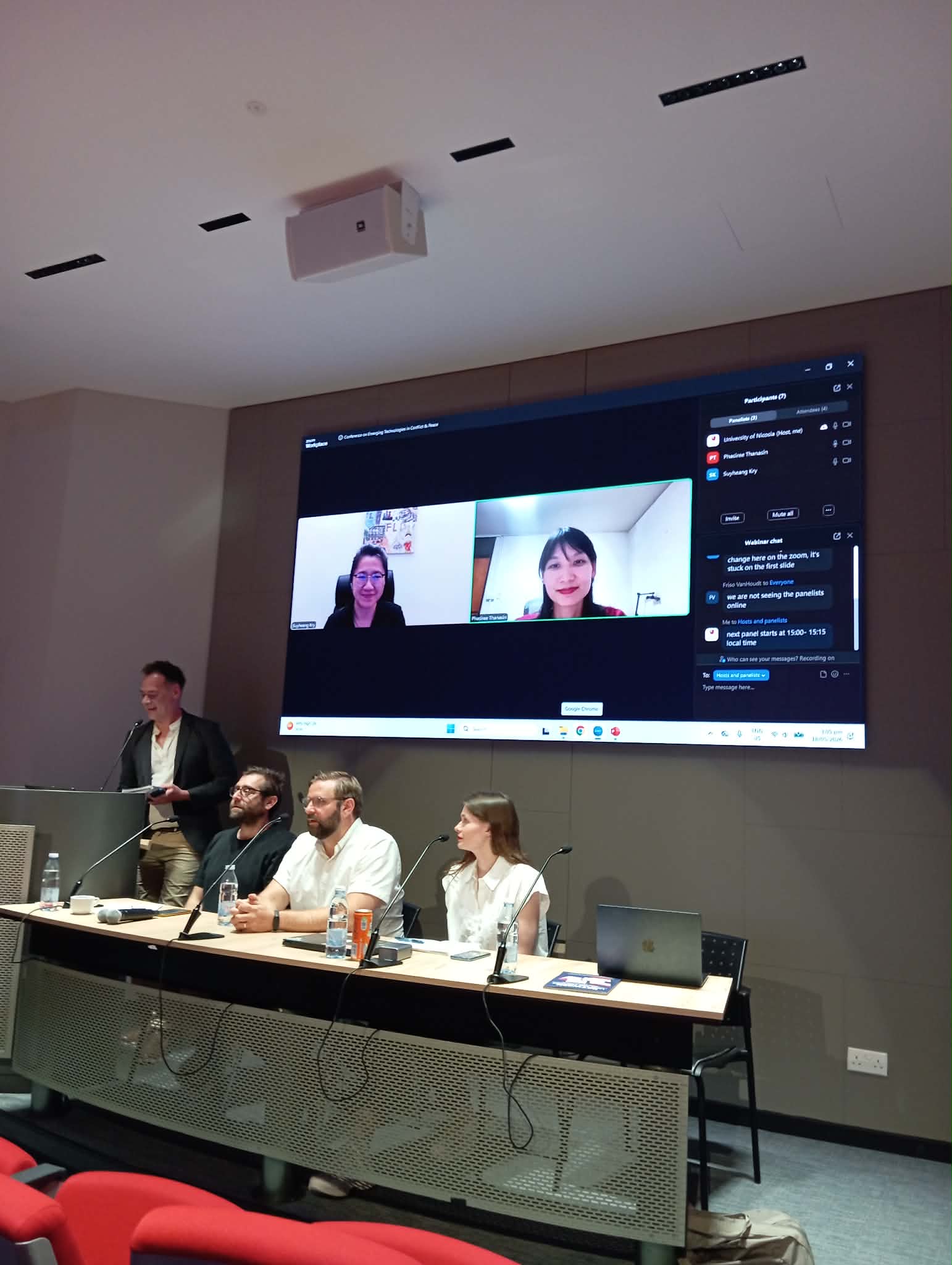
The conflict over the Preah Vihear Temple served as a central example. For Cambodians, the temple symbolizes national pride; for many Thais, disputes over the site evoke a sense of historical humiliation. Online discussions intensify these sentiments, transforming cultural disputes into digitally mediated “new trenches of battle.” Hyma’s participatory methodology, described as a facilitative listening design, treated researchers’ lived experiences as part of the data-generating process. This approach illuminated how digital communication technologies can exacerbate conflict while also offering insights into the emotional dimensions of nationalism.
Algorithmic Management and Labour Relations
Denis Neumann (University of Leeds)
Denis Neumann analyzed the effects of algorithmic management in platformized workplaces. He argued that digital systems create significant information asymmetries between workers and employers, increasing managerial arbitrariness and reinforcing existing inequalities between capital and labour.
Drawing on empirical research, Neumann demonstrated that works councils and collective representation remain highly relevant. Worker participation can improve shift scheduling, increase autonomy, and empower employees to challenge opaque algorithmic systems. The presentation offered an important reminder that technological power is not uncontested; institutional and collective interventions can shape how algorithms are implemented in practice.
Media Construction of the “Ethnic Hatred” Frame
Julia Gy. Molnár (Corvinus University of Budapest)
Julia Gy. Molnár investigated how Western media frame ethnic conflicts, focusing on reporting in The New York Times and The Guardian over a forty-five-year period. Using a corpus of nearly 6,000 articles, she found that 55–60 percent of coverage relied on primordialist explanations, portraying ethnic conflict as the inevitable consequence of ancient hatreds and irreconcilable identities.
Molnár traced the evolution of communication technologies from the 1980s to the present:1980s–1990s: technology as communication space
2000s: social media as amplifier
2020s: digital platforms as governance and geopolitical actors
Her findings challenge dominant media narratives and call for more historically and politically grounded interpretations of conflict.
Overarching Themes and Analytical Insights
Several cross-cutting themes emerged throughout the day:
- Technologies as Political Infrastructures
AI and emerging technologies are not neutral innovations. They are embedded in global structures of power and serve as infrastructures for governance, surveillance, and warfare.
- War as a Laboratory for Innovation
Military conflicts and occupied territories increasingly function as testing grounds where new technologies are developed, refined, and commercialized.
- Materiality and Ecological Costs
The digital economy depends on vast physical infrastructures, including semiconductors, minerals, data centres, and energy systems, with significant geopolitical and ecological implications.
- Algorithmic Governance and Subject Formation
Technologies shape not only institutional decisions but also identities, social norms, and forms of belonging.
Conclusion
The first day of the conference demonstrated the importance of critically examining emerging technologies through the lenses of peace and conflict research. Across diverse case studies—from semiconductor geopolitics and cloud infrastructures to biometric borders and digital nationalism—the presentations revealed that technology is inseparable from broader struggles over power, sovereignty, and social order. Artificial intelligence, digital platforms, and surveillance systems are reshaping the conditions of war, governance, labour, and identity. Yet they also generate new spaces for resistance and democratic contestation. The conference highlighted the urgent need for interdisciplinary scholarship that combines political economy, critical theory, and empirical research to understand how technological transformations are reconfiguring the contemporary world. The discussions in Nicosia made clear that emerging technologies are not only changing how societies function; they are redefining the fundamental political questions of our time: who governs, who is protected, who is rendered vulnerable, and what forms of peace and justice remain possible in an increasingly algorithmic world.

