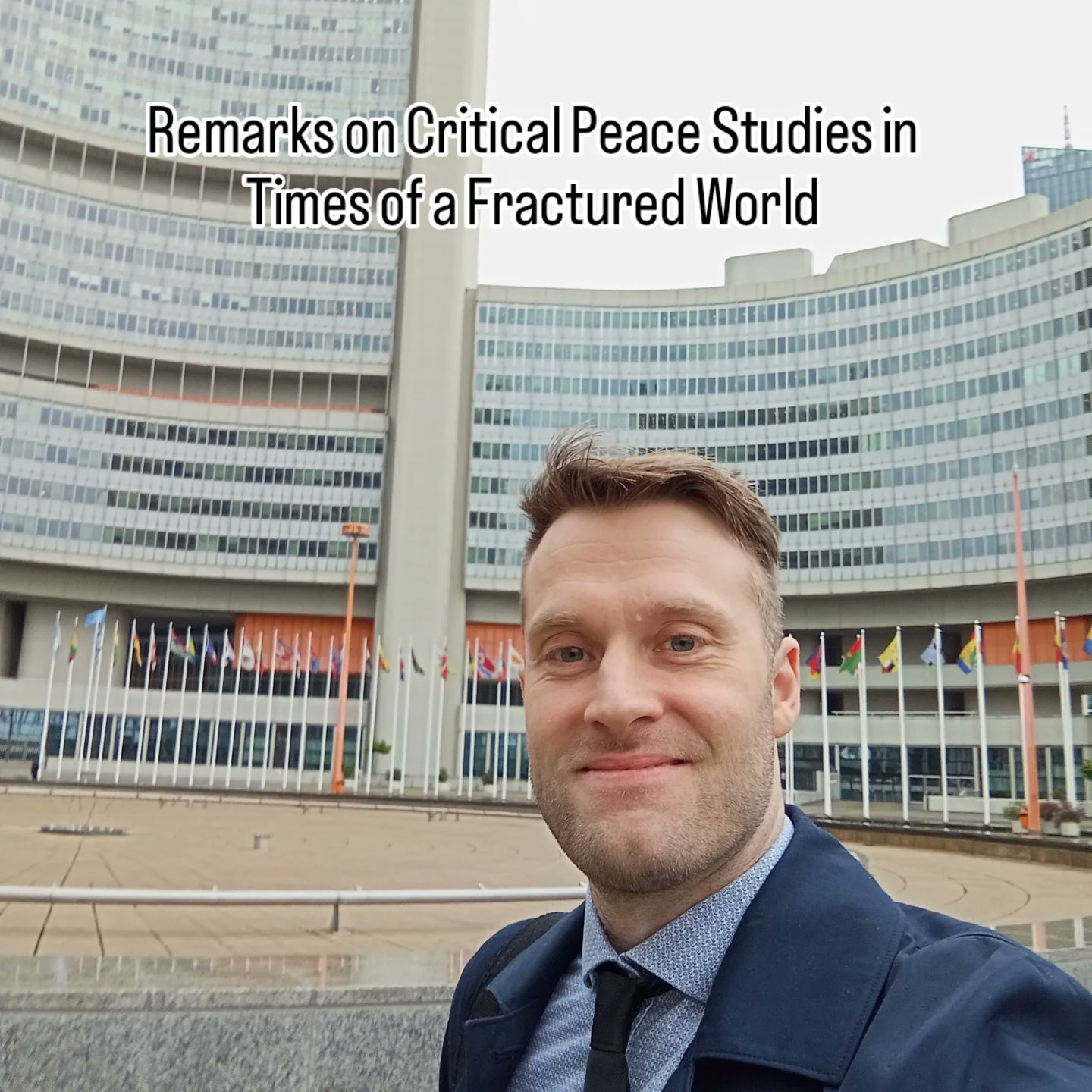
At the Vienna International Center (VIC) (the UN Body in Vienna, Austria), peace researcher and peace journalist Josef Mühlbauer from the University of Graz delivered an urgent appeal for peace and justice in his opening remarks to the UN NGO Committee on Peace. Speaking under the title “A Fractured World”, he reflected on the legacy of the United Nations as a cornerstone of diplomacy and human rights while warning of today’s crises. The Video reached in few months more than 7.000 views! That shows that the topic is still very important and matters to all of us!
Mühlbauer highlighted the devastating humanitarian situation in Gaza, calling it a test of the world’s commitment to the Universal Declaration of Human Rights. He also condemned the erosion of disarmament efforts, pointing to the reckless modernization of nuclear arsenals, while global resources are diverted away from fighting hunger, poverty, and climate change.
Central to his address was the role of Critical Peace Studies, which he framed around the revolutionary ideals of égalité, fraternité, and solidarité. He stressed that true peace is not merely the absence of war, but the presence of justice, inclusion, and equity. Drawing on examples from grassroots movements and nonviolent resistance, he argued that peace must be built through solidarity across borders and the dismantling of systems of oppression.
Closing his (emotional) speech, Mühlbauer urged the international community to reject the myth of inevitable violence and to invest in dialogue, justice, and the “messy but glorious work of peace.” His words stood as both a critique of current failures and a call to action for a more just and humane global order.
Josef Mühlbauer is the co-editor of several books, such as „Critical Peace Studies“ (Kritische Friedensforschung) (2024). He is a member of the Österreichischer Journalisten Club where he teaches for the certified course „Journalists4Peace“. Last but not least he is a University Assistant and Peace Researcher at the University of Graz in Austria.
For requests write here: josef.muehlbauer@uni-graz.at
Critical Political Economy Conference, 30 July 2025, Helsinki Finnland.
Report by Josef Mühlbauer, 4.8.2025.
The vibrant and historically resonant city of Helsinki – famously divided between its „red“ workers‘ districts and „white“ bourgeois quarters – provided a fitting backdrop for the opening day of the Critical Political Economy Conference. The atmosphere was charged with critical inquiry, underscored by the symbolic singing of the „Internationale“ at the long bridge. I was honoured to be among the invited speakers, presenting my work alongside insightful contributions from international scholars.
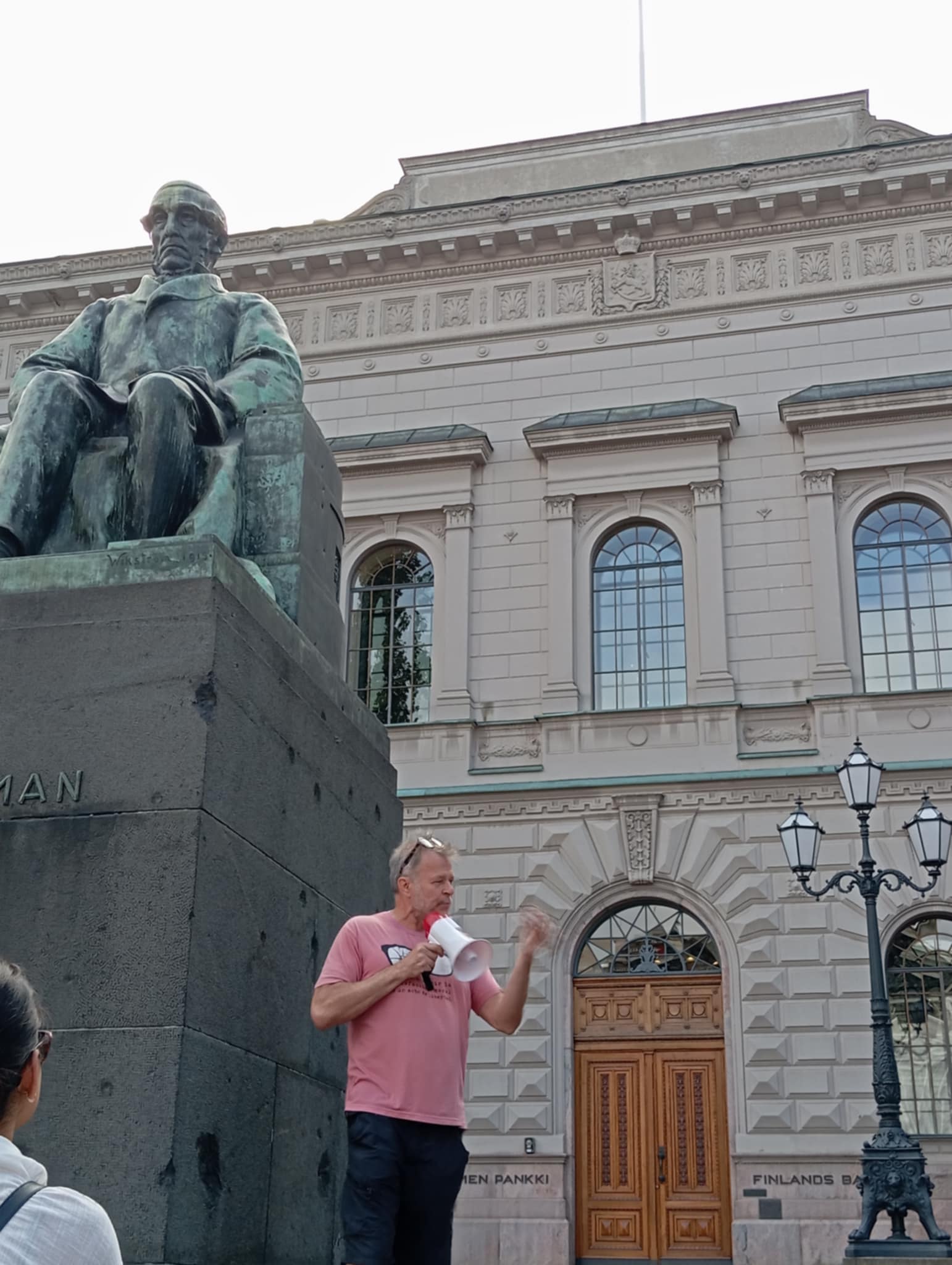
Prof. Teivo Teivainen was not only one of the organizers and hosts of this event, he also took the time and went on a city tour with the participants of the conference and talked about the history and political development of Helsinki.
Workshop:Narrating the Global Water Crisis (Gemma Gasseua & Madelaine Moore): Gasseua and Moore dissected the narratives emerging from the 2023 UN Water Conference. Their research revealed how the framing of the water crisis shifts dramatically depending on the sector: businesses focus on pricing, environmental movements on climate change, while critical issues like „water grabbing“ and decades of social struggle are systematically silenced or obscured. Gasseua powerfully argued for viewing water through a feminist lens, essential for social reproduction.
Workshop: How to be Anti-AI in the 21st Century (David Bailey): Prof. Bailey delivered a trenchant critique of Artificial Intelligence under capitalism. He argued AI’s harms stem not from the technology itself, but from its deployment within exploitative systems: intensifying worker precarity, enabling surveillance (e.g., its use in the Gaza war), consolidating oligarchic power, and accelerating ecological damage and racialized extractivism. His core message challenged the „inevitability narrative“ surrounding AI.
Workshop: Shaping the South: 19th Century British Interests in Latin America (Dr. Perla Polanco Leal): Dr. Polanco Leal explored Britain’s „Informal Empire“ in Latin America. Faced with the high costs of formal colonization, Britain instead used diplomacy, investment, and infrastructure (railways, ports, telegraphs) to establish systematic value extraction. This involved detailed geological surveys and entrenched exploitative labor practices, creating enduring extractive economic models and reinforcing racialized hierarchies in production and trade.
Impressions:
Johannes Jäger FH Wien presented his latest project. (c): Josef Mühlbauer, Helsinki, 30.7 – 1.8.2025
My Presentation: Navigating the Interregnum – Polycrisis and Liquid Modernity
My contribution, „Interregnum, Polycrisis, and the Concept of Liquid Modernity: Navigating the Current Conjuncture,“ sought to provide theoretical frameworks for understanding our profoundly unstable times.
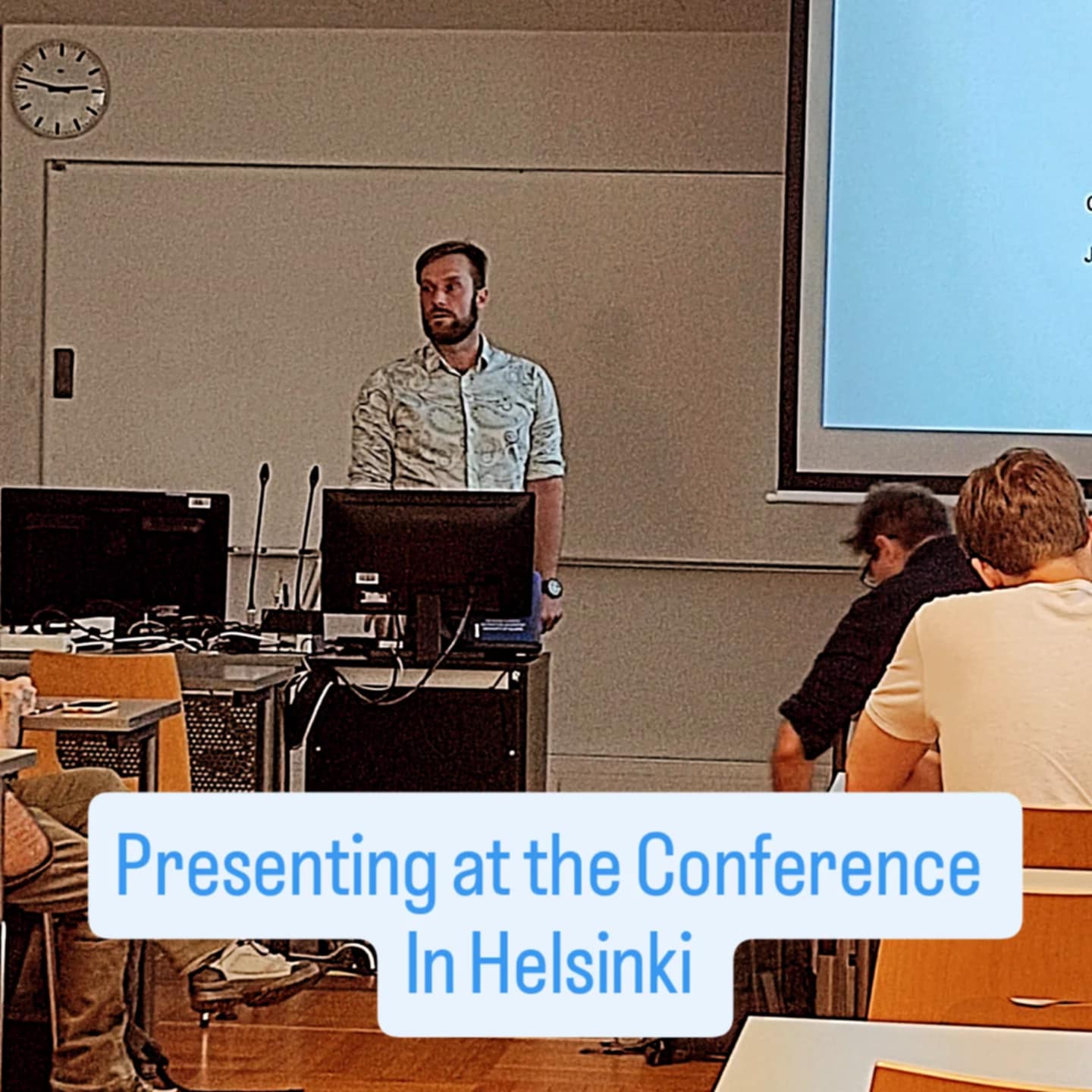
Josef Mühlbauer presenting at the Conference in Helsinki, Finnland. (c): Josef Mühlbauer 1.8.2025.
Interregnum: Drawing on Gramsci, I framed our era as an „interregnum“ – a period where the old structures and certainties (political, economic, social) are dying, but the new ones have not yet been born. This manifests as a pervasive sense of dislocation, institutional crisis, and a struggle over what comes next. Helsinki’s own historical divisions felt emblematic of this global condition.
Polycrisis: I argued we are not facing isolated crises (ecological, economic, political, social), but a polycrisis – a dense web of interconnected, mutually reinforcing crises. The water crisis discussed by Gasseua & Moore, the exploitative logic of AI critiqued by Bailey, and the legacies of extractivism analyzed by Polanco Leal are not separate issues; they are facets of this singular, complex polycrisis rooted in global capitalism’s contradictions.
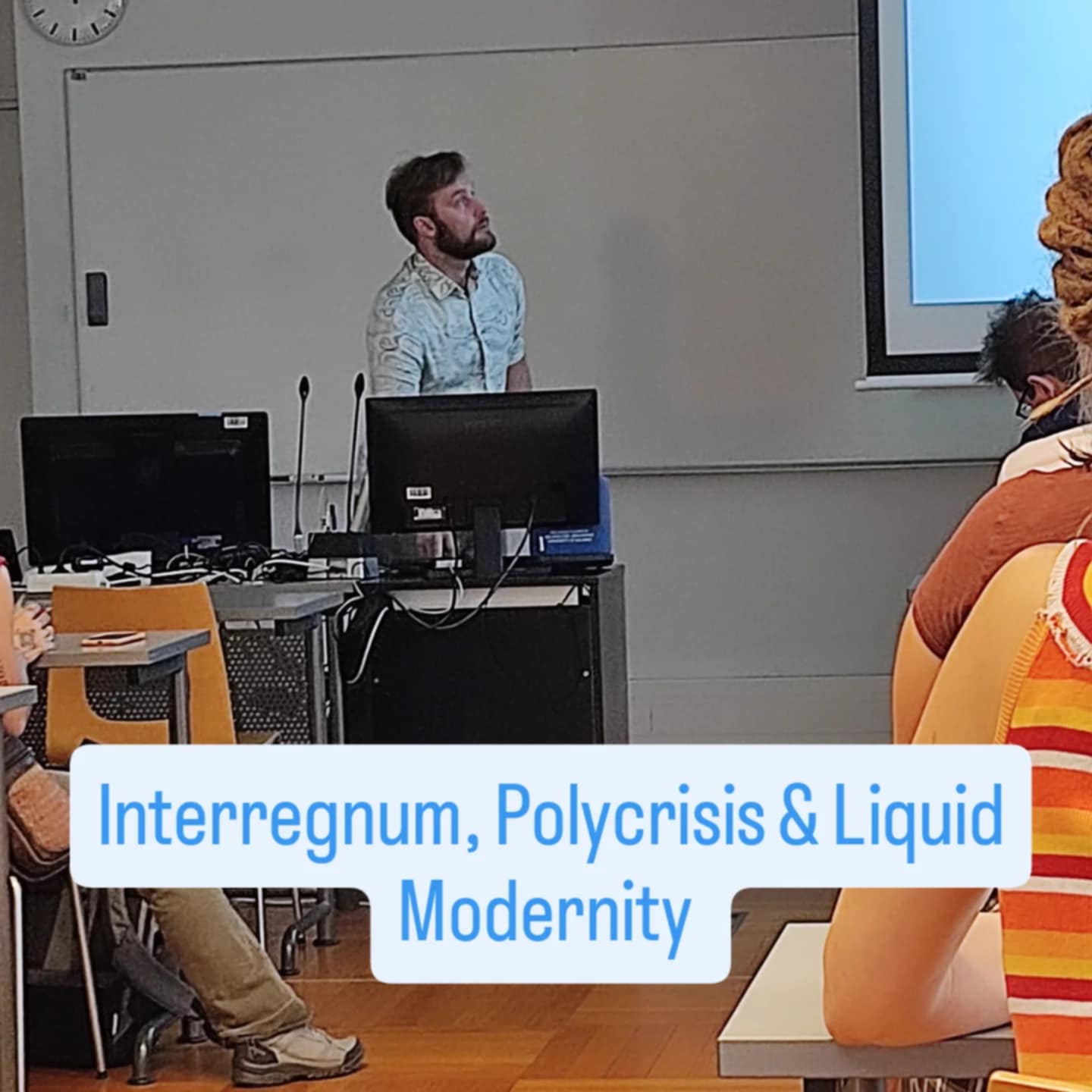
Josef Mühlbauer presenting at the Conference in Helsinki, Finnland. (c): Josef Mühlbauer 1.8.2025.
Liquid Modernity (Bauman): Finally, I employed Zygmunt Bauman’s concept of „liquid modernity“ to understand the experience of this interregnum and polycrisis. Our social bonds, institutions, and even identities feel fluid, unstable, and perpetually in flux. Solid structures melt away, replaced by uncertainty and a constant demand for adaptation. This liquidity makes collective action challenging yet simultaneously underscores its desperate necessity.
Understanding these three concepts together is crucial for developing critical political economy strategies capable of navigating this turbulent period and forging pathways beyond the crisis of the present.




 Josef Mühlbauer