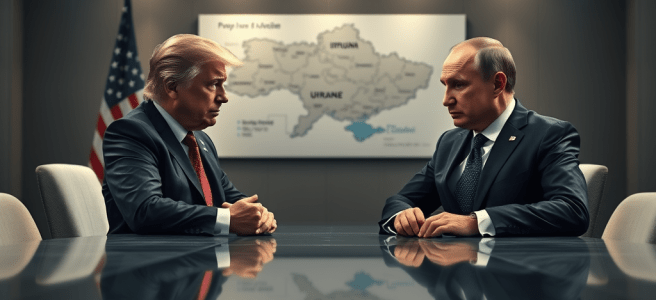
Context of the „Peace Negotiations“ in Alaska (2025):
The prospect of peace negotiations (Alaska 2025) between the US, and Russia represents one of the most critical geopolitical junctures of the 21st century. Therefore it is important to understand the broader picture. The ongoing „peace negotiations“ between the US and Russia cannot be understood merely as a tactical chess game between great powers (realist school). We need to consider raw materials, the imperial mode of living (capistalist mode of production), and class struggle in order to see the bigger picture.
Great Power Bargaining? One Part of the Picture: (Neo-)Realism
Although there are no direct and official peace negotiations between the US/Russia and Ukraine, there are signals from the great powers that suggest a preparation for potential „back-channel talks“. Trump has repeatedly claimed he would end the Ukraine war in only „24 hours“, implying a willingness from the US to pressure Ukraine into concessions, most likely involving the (de facto not de jure!) recognition of Russian control over Crimea and the annexed territories (like the Donbas) in exchange for a ceasefire and peace deal. Peace in that regard comes with a price tag. This approach aligns with a (neo-)Realist school of thought, most famously articulated by Prof. John Mearsheimer, which analyzes this war as a great power proxy conflict. Ukraine in that sense is seen as the „backyard“ of Russia. In other words, Ukraine is in the sphere of influence of Russia. From this (neo-)Realist perspective, NATO’s eastward expansion encroached on Russia’s sphere of influence, provoking a predictable and brutal response. The great power bargaining, or the Realist negotiation, would therefore involve:
- Neutrality of Ukraine
- Recognizing Russia’s regional security interests
- No NATO expansion to the east, near the Russian border.
The Bigger Picture Contains Class Struggle & Raw Materials: Critical Peace Studies
While valuable, this theoretical framework overlooks other key dimensions (Denys Pilash 20.08.2025, Democracy Now).
It is overwhelmingly working-class men—both Ukrainian and Russian—who are dying on the frontlines. The war reproduces social inequalities where elites decide, and ordinary citizens pay the price. Ukraine is rich in critical raw materials such as lithium, titanium, and rare earths. These resources are central to the global competition over energy transition, technology, and future economic power (see also the Critical Raw Material Act, 2023). Both the US/EU and Russia have vital interests in securing or denying access to them. Thus, the war is not only about borders or NATO but also about the material basis of 21st-century industrial strategy. The current imperial mode of living contains a mode of production that is heavily dependent on critical raw materials and the exploitation of cheap labor force. In that sense, critical peace scholars highlight that in order to make a lasting peace deal one needs to create more just ways of living. Before I dig deeper into that approach, my take on the Alaska „peace talks“.
My Take on the Alaska Meeting:
In 1784, Grigorii Shelikhov established the first permanent Russian outpost on Kodiak Island at Three Saints Bay (Russian Colonization of Alaska). Eager to eliminate rival Russian companies and gain control of the entire North Pacific fur trade, Shelikhov expanded the sphere of Russian influence along the Alaskan coast and petitioned Empress Catherine the Great to grant him a monopoly (full essay). Alaska was Russian America until its purchase by the United States in 1867, therefore Alaksa can be seen as a source of Putins imperial nostalgia. For Russia (under the Tsar), it was a distant, difficult-to-defend territory that became a financial liability. For the emerging US, it was a strategic masterstroke, adding immense natural resources and extending its Pacific power projection. Its importance today is not territorial but diplomatic and symbolic. It stands as the prime example of a peaceful, large-scale territorial transaction between the two powers. It represents a time when US and Russian interests, despite mutual suspicion, could be reconciled through pragmatic negotiation. On the other hand, it shows the imperialist behaviour of Tsarist Russia and the US. On the surface, it was a peaceful and pragmatic deal, but beneath that, it was a fight for hegemony and expanding its sphere of influence. Therefore Alaksa means inner-imperialist negotiations, or great power chess games. For both, Putin and Trump, this is of course the right place to talk.
Many analysts portray Donald Trump’s accommodating stance toward Putin as born of personal admiration or even susceptibility (Michael Clarke 20.08.2025, Skye News). A more compelling, strategic explanation is that it stems not from a fear of Putin the person, but from a prudent and acute fear of the logical endpoint of uncontrolled escalation: a direct NATO-Russia war or nuclear exchange. This is not weakness; it is a form of realist caution. The fundamental principle of Mutually Assured Destruction (MAD) that governed the Cold War still applies.
Pathways to a Lasting and Just Peace: Critical Realism
Maybe Prof. Mearsheimer is correct. In the short to medium term, stability will require a realist bargain between the superpowers. Security guarantees for Ukraine would involve states from the global south, and from Europe to ensure the sovereignty of Ukraine within its agreed borders. Security guarantees for Russia would involve negotiations on NATO expansion and the limits on missile deployments. Treaties like START, INF, and Open Skies should be implemented again. Security for European powers would involve the reduction of energy and military dependence on both the US and Russia, granting Europe more strategic autonomy.
From a critical peace and critical realist stance, these described guarantees will only freeze the conflict. Long-term, resilient peace should address the root causes. This means supporting Ukrainian and Russian anti-war and pro-democracy movements. Only peace negotiations from below have more legitimacy. Elites can easily mobilize a poor or indoctrinated population for war; therefore, the reduction of the grotesque inequality within and between states should be the top priority of governments. Last but not least, local voices should be heard from all sides of the war. Economic, political, and cultural ties across the region should be created. Besides „Realpolitik“, we need to understand peace negotiation not as a single decision by rich and powerful (old, white) men, but as a complex process that includes the war’s material basis (resource competition, capitalism) and its „human cost“ borne by the working class.
Of course, this is not the full picture, but hopefully, it is a bigger one than that portrayed by the Realist school of thought or by liberal thinkers.
Josef Mühlbauer, Author of several books and scienfitic articles, (Keynote) Speaker, Peace Journalist at the Varna Institute for Peace (VIPR), Peace Researcher at the University of Graz in the field of Critical Peace Studies. Member and scientific researcher at the NGO „Empowerment for Peace“ (EfP).


 Josef Mühlbauer