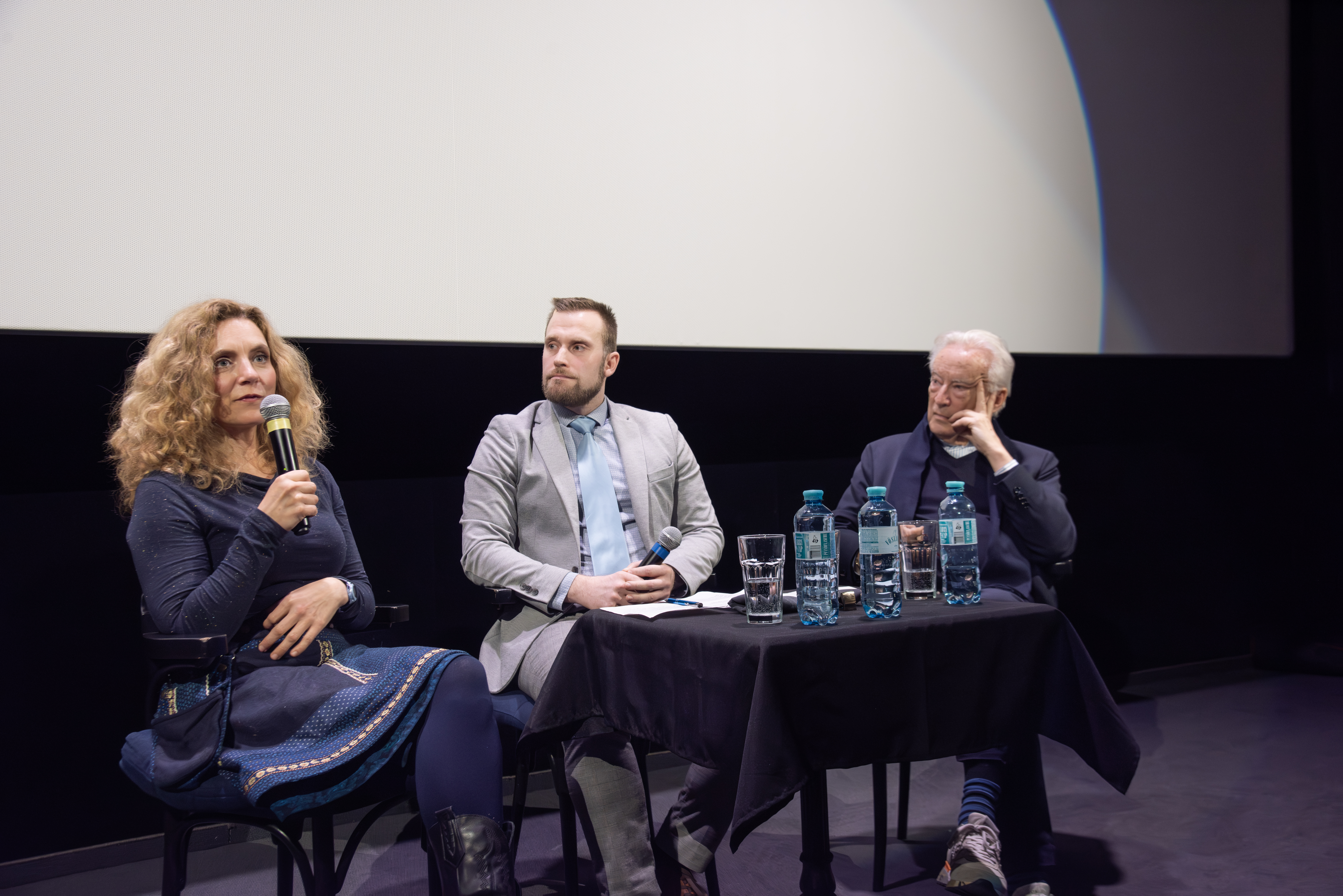
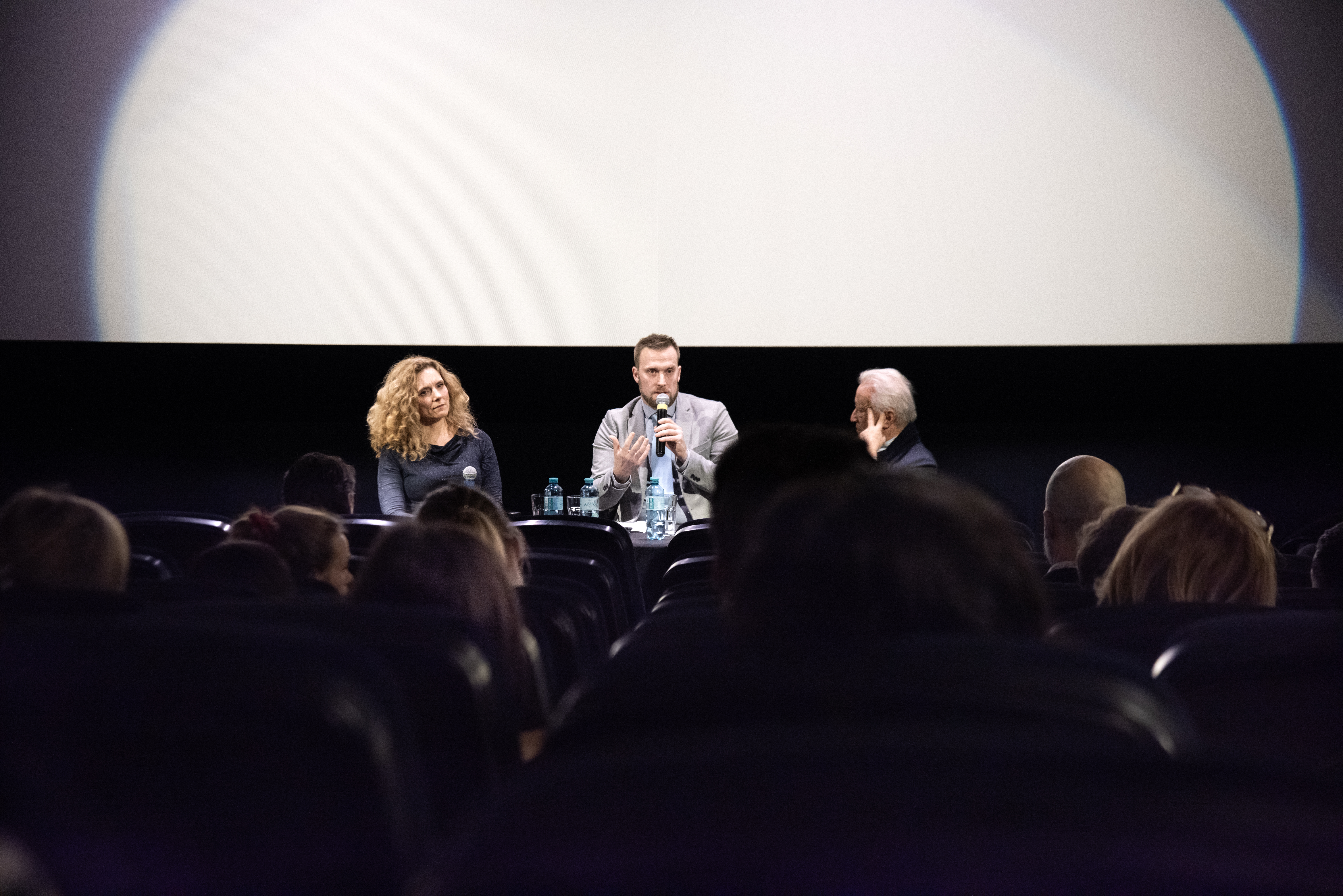
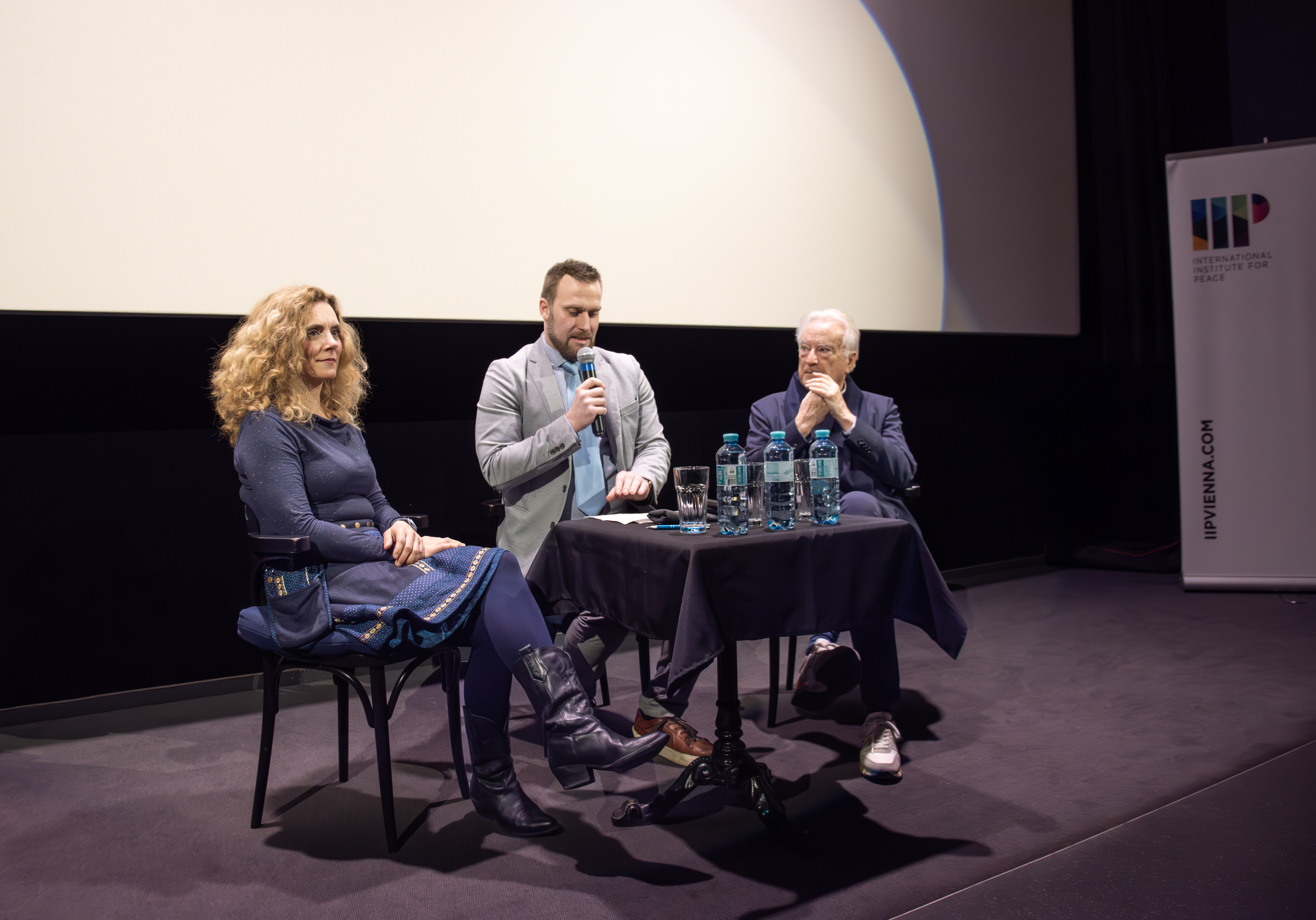
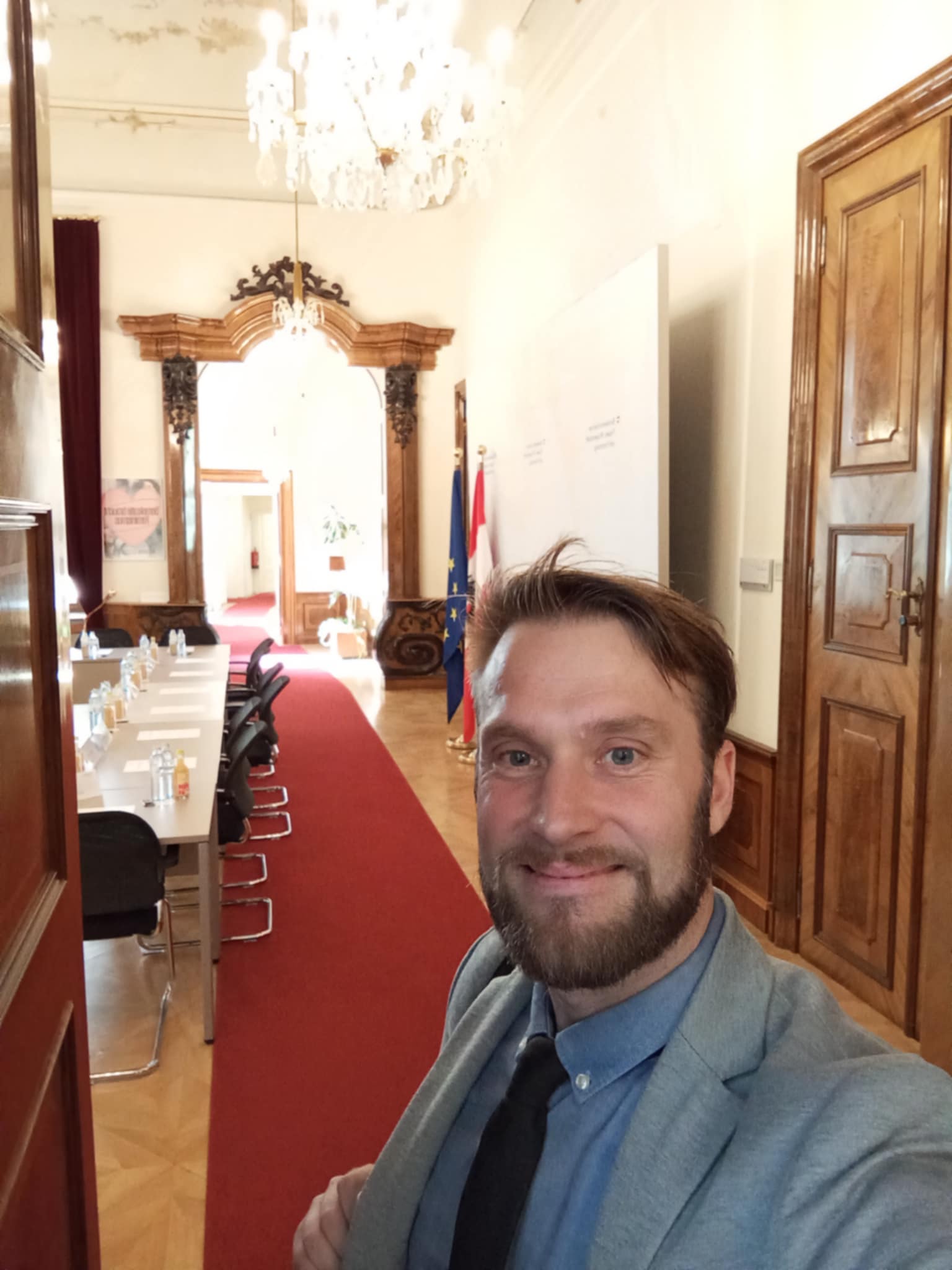
Krieg & Friedensbewegung – Feministische Perspektiven (Buchvorstellung)

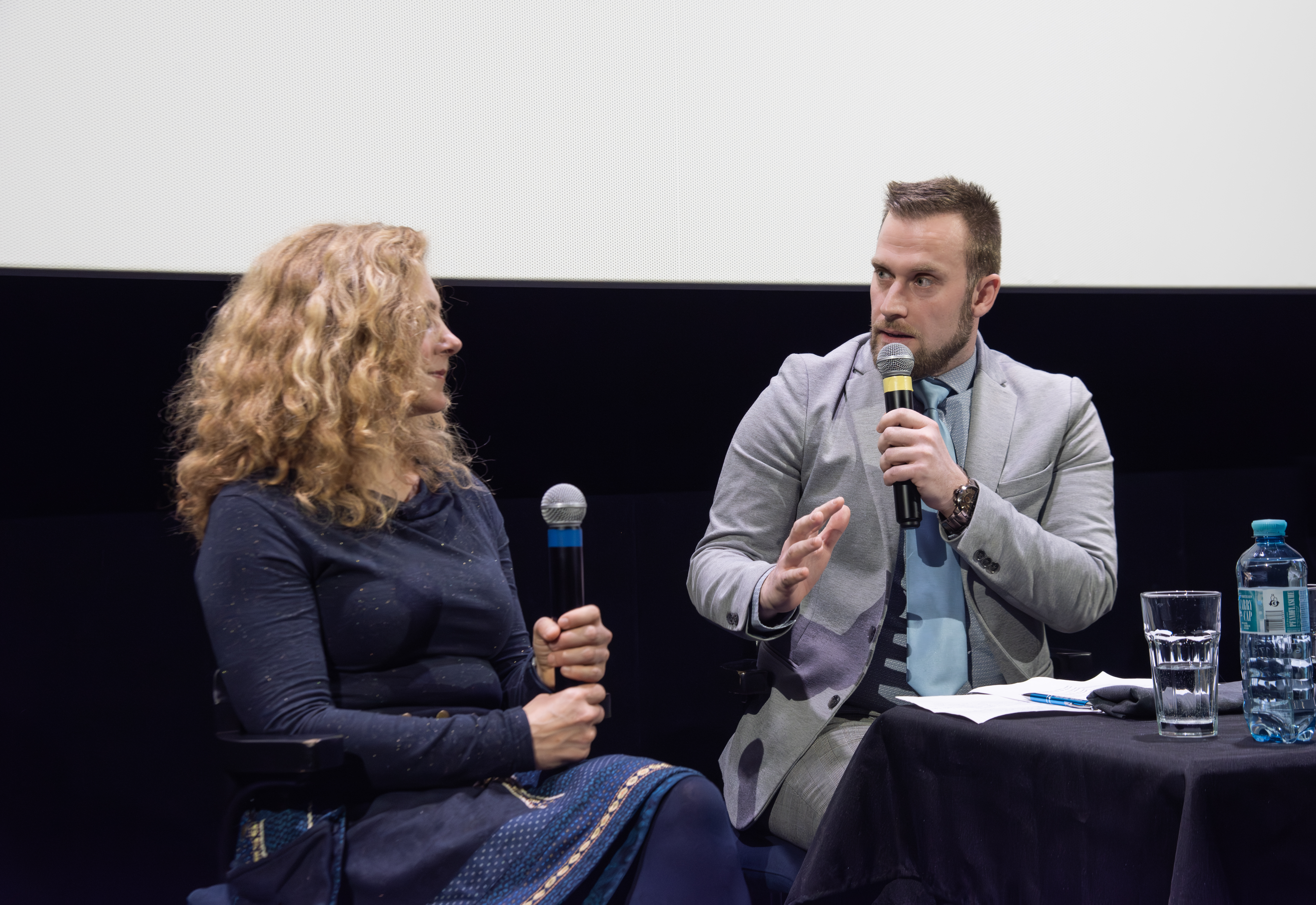
Friedensforscher Josef Mühlbauer moderiert Panel zu Krieg und Frieden

Abonnieren, um weiterzulesen

Schließe ein Abonnement ab, um Zugriff auf den Rest dieses Beitrags und weitere exklusive Inhalte für Abonnenten zu erhalten.

Sicherheit ohne Waffen? – Weltdokumente-Erbe für den Frieden

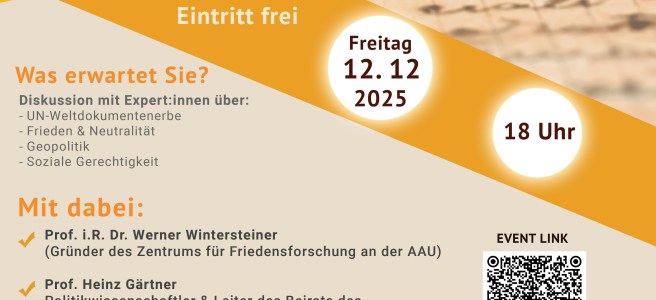
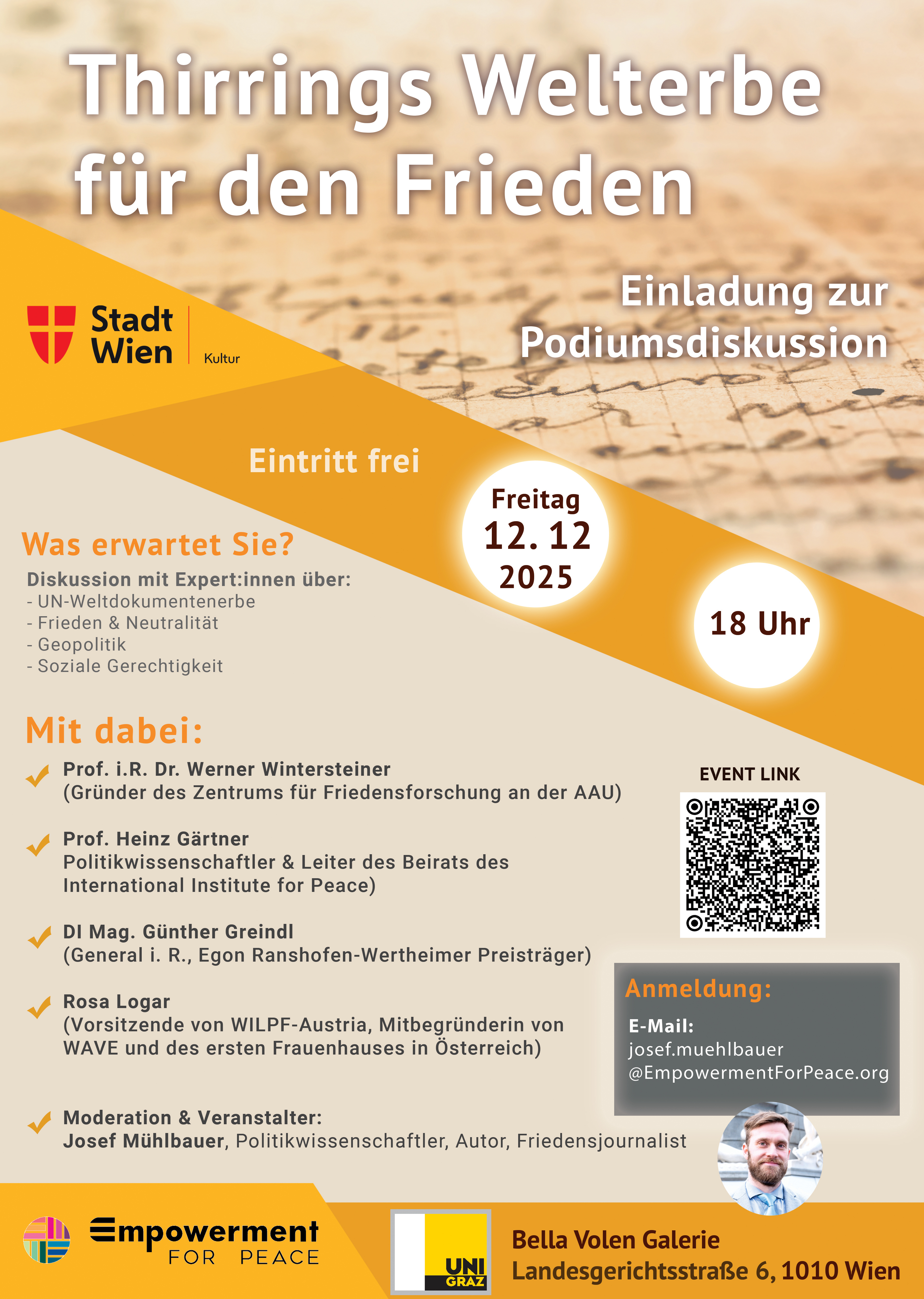
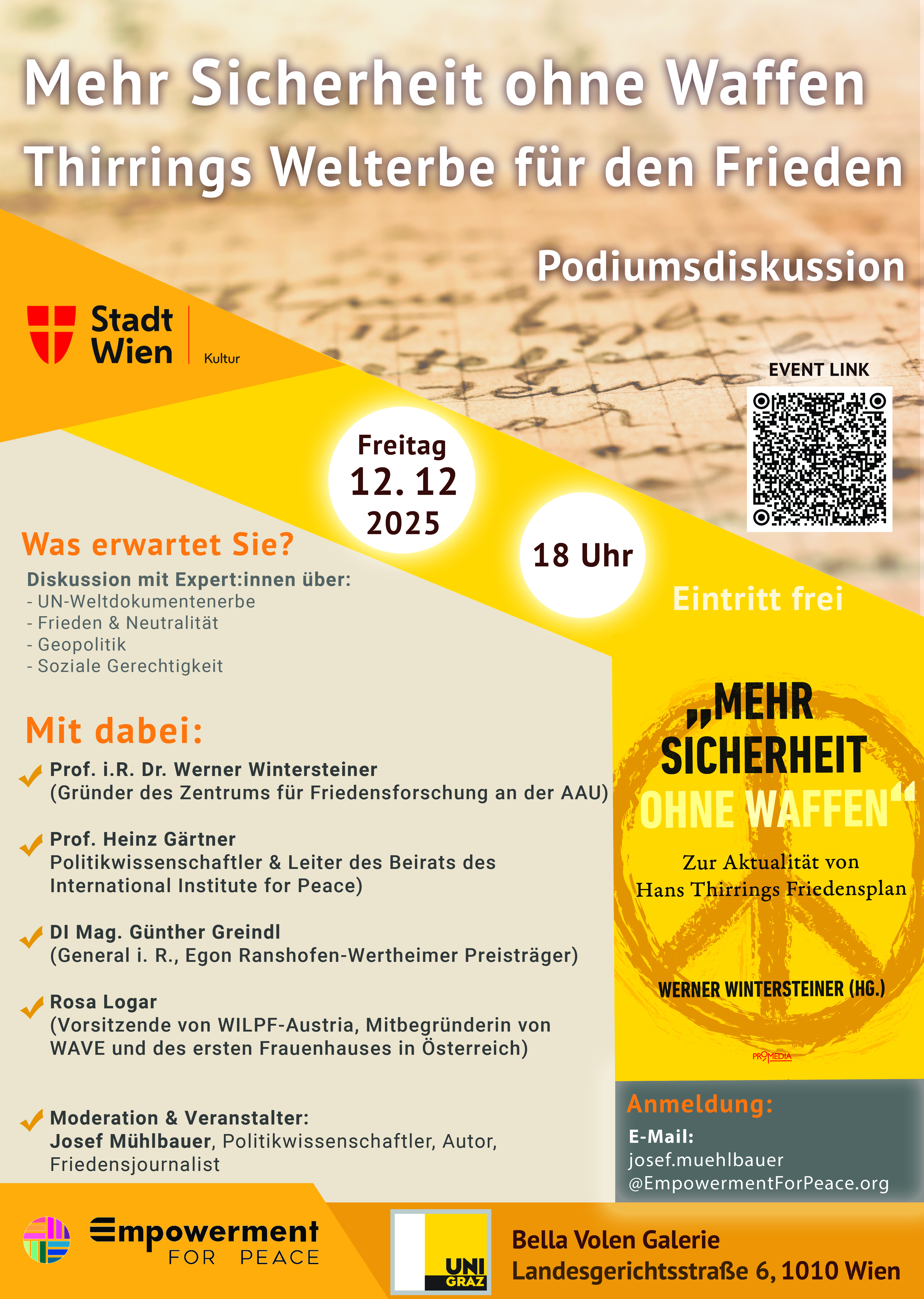
Sicherheit ohne Waffen? – Weltdokumente Erbe für den Frieden Wie können wir Frieden und Sicherheit neu denken – jenseits militärischer Logik und Aufrüstung? Anlässlich des „Weltdokumente Erbes für den Frieden“ von Hans Thirring lade ich euch herzlich zu einer spannenden Podiumsdiskussion ein, die genau dieser Frage nachgeht. Die Teilnahme ist kostenfrei, eine Anmeldung ist erforderlich: https://www.eventbrite.com/e/podiumsdiskussion-thirrings-un-weltdokumentenerbe-fur-den-frieden-tickets-1842660038779?aff=erelpanelorg

Podiumsdiskussion am 12. Dezember 2025, 18:00 Uhr, Bella Galerie Wien

podiumsdiskussion-thirrings-welterbe-fuer-den-frieden

Wie können wir Frieden und Sicherheit neu denken – jenseits militärischer Logik, Aufrüstung und Abschreckung?
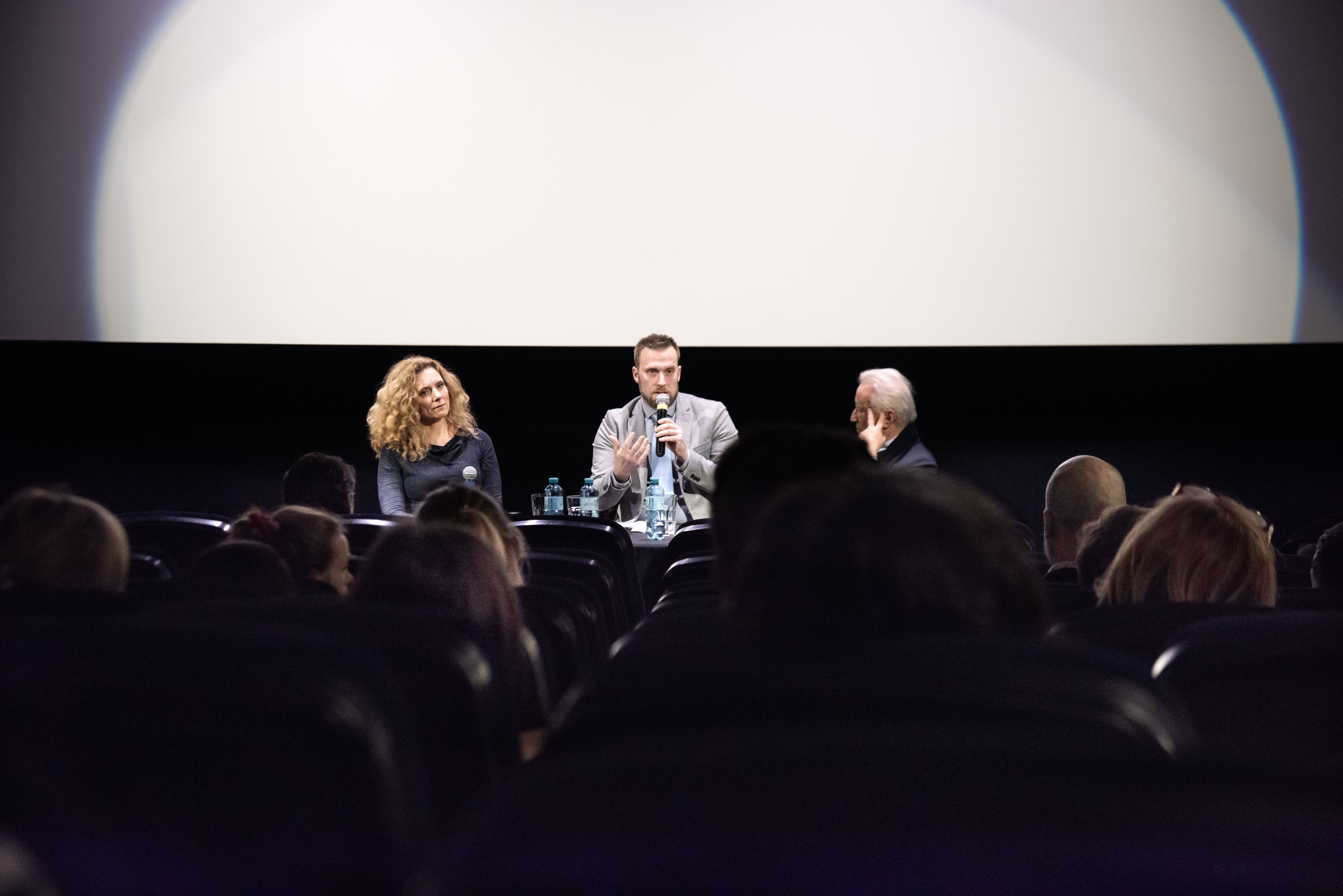
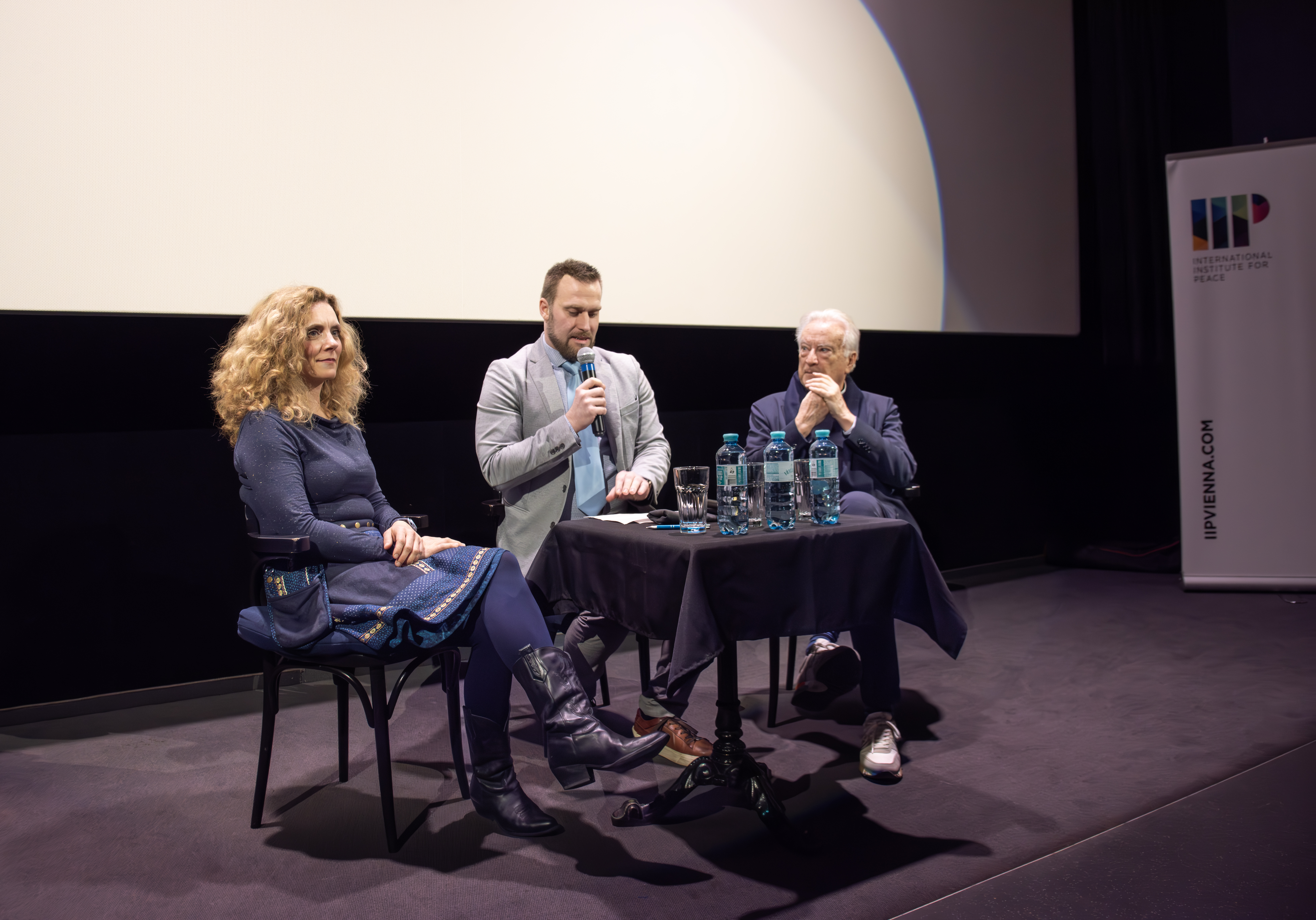
Diese Frage steht im Zentrum einer besonderen Podiumsdiskussion, die anlässlich des „Weltdokumente-Erbes für den Frieden“ von Hans Thirring stattfindet. Sie führt Expertinnen und Experten aus Wissenschaft, Friedensforschung und feministischer Friedensarbeit zusammen – moderiert vom Friedensforscher Josef Mühlbauer.

Hans Thirring: Physiker, Pazifist und Visionär

Der Name Hans Thirring (1888–1976) ist heute vor allem Physikerinnen und Physikern ein Begriff – als jener Wiener theoretische Physiker, der gemeinsam mit dem deutschen Kollegen Lense den sogenannten Lense-Thirring-Effekt beschrieb: die „Raum-Zeit-Verdrehung“ um rotierende Massen, ein wichtiger Beitrag zur Allgemeinen Relativitätstheorie von Albert Einstein.

Doch Thirring war weit mehr als ein bedeutender Wissenschaftler. Nach dem Ersten Weltkrieg entwickelte er sich zu einem der konsequentesten pazifistischen Intellektuellen Österreichs. Tief erschüttert von den Erfahrungen des Krieges setzte er sich für Abrüstung, internationale Verständigung und eine Erziehung zum Frieden ein. Bereits in den 1920er Jahren schrieb Thirring eindringliche Texte gegen die militärische Logik und warnte vor einer neuen Aufrüstungsspirale – lange bevor diese in den 1930er Jahren Realität wurde.

Sein Werk „Die mechanische Weltanschauung und ihre Zertrümmerung“ gilt bis heute als einflussreiche Auseinandersetzung mit den ethischen und erkenntnistheoretischen Konsequenzen moderner Naturwissenschaft.
Nach dem Zweiten Weltkrieg engagierte sich Thirring verstärkt für die Friedensbewegung, trat für atomare Abrüstung ein und setzte sich für eine friedensorientierte Bildung ein.

Seine Schriften und Manuskripte wurden 2023 in das UNESCO-Weltdokumentenerbe „Memory of the World“ aufgenommen – als „Weltdokumente-Erbe für den Frieden“. Sie dokumentieren die Verbindung von wissenschaftlicher Vernunft, ethischer Verantwortung und politischer Zivilcourage.

Das Podium besteht aus renommierten Expert:innen aus Österreich:

Frieden neu denken – das Podium

Die Veranstaltung „Sicherheit ohne Waffen?“ knüpft an Thirrings Vermächtnis an. Sie lädt ein, über aktuelle Formen der (Un-)Sicherheit, die Militarisierung Europas und Alternativen zu sicherheitspolitischem Denken in Blöcken zu diskutieren. Drei profilierte Persönlichkeiten und geniale Akademiker:innen bringen dabei unterschiedliche Perspektiven ein:

Prof. Werner Wintersteiner – Pädagoge des Friedens

Werner Wintersteiner ist einer der bekanntesten österreichischen Friedensforscher. Als Gründer und langjähriger Leiter des Zentrums für Friedensforschung und Friedenspädagogik an der Alpen-Adria-Universität Klagenfurt hat er entscheidend dazu beigetragen, Friedenspädagogik im deutschsprachigen Raum zu etablieren.
Er plädiert für ein „poetisches Denken des Friedens“ – ein Konzept, das Frieden nicht nur als politische Abwesenheit von Krieg, sondern als kulturelle, kommunikative und imaginative Praxis versteht. Wintersteiner fordert, Sicherheit neu zu denken: weg von militärischer Logik, hin zu sozialer Gerechtigkeit, Bildung und ökologischer Nachhaltigkeit. Mit seinem Buch „Sicherheit ohne Waffen“ trifft er den Nerv unserer Zeit.

Prof. Heinz Gärtner – Politikwissenschaftler und Sicherheitsexperte

Heinz Gärtner, Professor an der Universität Wien und langjähriger wissenschaftlicher Leiter des Österreichischen Instituts für Internationale Politik (oiip), ist einer der führenden Experten für internationale Sicherheitspolitik, Neutralität und Rüstungskontrolle.
Er analysiert die sicherheitspolitischen Spannungsfelder zwischen kollektiver Verteidigung, Abschreckung und kooperativer Sicherheit. Gärtner zeigt in seinen Arbeiten immer wieder auf, dass militärische Dominanz keine nachhaltige Stabilität schafft – und dass die europäische Friedensordnung auf Diplomatie, Vertrauen und Dialog aufbauen muss – ganz im Sinne einer glaubwürdigen und aktiven Neutralität (#BrunoKreisky).

Rosa Logar – Feministin und Friedensaktivistin

Rosa Logar ist eine der prägenden Stimmen der feministischen Friedensarbeit in Österreich. Sie ist Mitbegründerin und Aktivistin der Women’s International League for Peace and Freedom (WILPF) Austria – einer der ältesten internationalen Frauenfriedensorganisationen der Welt, gegründet 1915 während des Ersten Weltkriegs. Sie hat darüber hinaus als erste in Österreich Frauenhäuser mit ins Lebens gerufen und WAVE gegründet. Sie ist eine Pionierin im Bereich Frauenrechte und Gewaltprävention.
Logar verbindet in ihrer Arbeit feministische Außenpolitik, Menschenrechte und Gewaltprävention. Sie macht deutlich, dass patriarchale Machtstrukturen und militärische Logiken eng miteinander verknüpft sind – und dass Frieden nur dann nachhaltig ist, wenn er auf Gleichberechtigung, sozialer Teilhabe und kollektiver Sicherheit basiert.

General i.R. Günther Greindl – ist ein ehemaliger Berufsoffizier des österreichischen Bundesheeres mit dem letzten Dienstgrad General. Er war an verschiedenen UN-Missionen in leitender Stellung für die österreichische Abordnung und auch in militärnahen diplomatischen Verwendungen tätig. Anschließend war er bis April 1979 stellvertretender Generalstabschef im Verteidigungsministerium. Es folgte ein weiterer UN-Einsatz als Chef der Beobachtertruppe UNDOF (UNDOF Ausbatt) auf den Golanhöhen an der Grenze zwischen Israel und Syrien. Danach war er von 1981 bis 1989 Befehlshaber der UN-Friedenstruppen und Kommandant der Kontrolltruppe UNFICYP auf Zypern. Nach Beendigung dieser Tätigkeit als UN-Force-Commander wurde Greindl 1989 als österreichischer Verteidigungsattaché in die Schweiz entsandt. Im April 1991 wurde er erneut mit einer Mission der Vereinten Nationen betraut und zum Chief Military Observer der United Nations Iraq-Kuwait Observation Mission (UNIKOM) ernannt. Nach seiner Rückkehr wurde er zum Leiter der Generalstabsgruppe für Militärpolitik und Sicherheitskooperation bestellt, eine Funktion, die er bis 2000 innehatte.

Moderation: Josef Mühlbauer – Friedensforscher, Autor und Speaker

Moderiert wird die Diskussion von Josef Mühlbauer, Friedens- und Konfliktforscher an der Universität Graz. Er verbindet akademische Analyse mit gesellschaftlichem Engagement. Als politischer Wissenschaftler beschäftigt er sich mit globaler Governance, Demokratie und Konflikttransformation – und moderierte bereits zahlreiche Panels zu den Herausforderungen einer friedensorientierten Weltordnung.

Für ihn ist Thirrings Vermächtnis hochaktuell: „Hans Thirring hat früh erkannt, dass Frieden nicht militärisch hergestellt werden kann. In einer Zeit, in der wieder massiv aufgerüstet wird, ist es wichtiger denn je, diese Frage neu zu stellen: Was bedeutet Sicherheit wirklich – und für wen?“

Ein Erbe für die Zukunft

Das „Weltdokumente-Erbe für den Frieden“ von Hans Thirring erinnert daran, dass Wissenschaft und Ethik untrennbar verbunden sind. Es fordert uns auf, das Verhältnis von Wissen, Macht und Verantwortung kritisch zu reflektieren.

In einer Welt, die zunehmend von geopolitischen Konflikten, Klimakrisen und sozialen Spannungen geprägt ist, braucht es neue Ansätze für Sicherheit – Ansätze, die nicht auf Waffen, sondern auf Kooperation, Bildung und Gerechtigkeit beruhen.

Veranstaltungsdetails

📅 Datum: Freitag, 12. Dezember 2025
🕕 Uhrzeit: 18:00 Uhr
📍 Ort: Bella Volen Galerie, Landesgerichtsstr. 6, 1010 Wien, Nähe U2 Rathaus
🎟️ Eintritt: frei – Anmeldung erforderlich unter: https://www.eventbrite.com/e/podiumsdiskussion-thirrings-un-weltdokumentenerbe-fur-den-frieden-tickets-1842660038779?aff=erelpanelorg

Sicherheit ohne Waffen? – Weltdokumente Erbe für den Frieden Wie können wir Frieden und Sicherheit neu denken – jenseits militärischer Logik und Aufrüstung? Anlässlich des „Weltdokumente Erbes für den Frieden“ von Hans Thirring lade ich euch herzlich zu einer spannenden Podiumsdiskussion ein, die genau dieser Frage nachgeht. Die Teilnahme ist kostenfrei, eine Anmeldung ist erforderlich: https://www.eventbrite.com/e/podiumsdiskussion-thirrings-un-weltdokumentenerbe-fur-den-frieden-tickets-1842660038779?aff=erelpanelorg

„Sicherheit ohne Waffen?“ ist mehr als der Titel einer Podiumsdiskussion – es ist eine Herausforderung an unser Denken.
Das Vermächtnis Hans Thirrings, das Engagement der Diskutierenden und die offene Diskussion zeigen:
Frieden beginnt mit der Frage, wie wir denken – und mit dem Mut, anders zu denken. Seid dabei!

#Friedensforschung #Friedensjournalismus #Podiumsdiskussion #Wien #WienEvents #Friedensdiskussion #Kunstgalerie

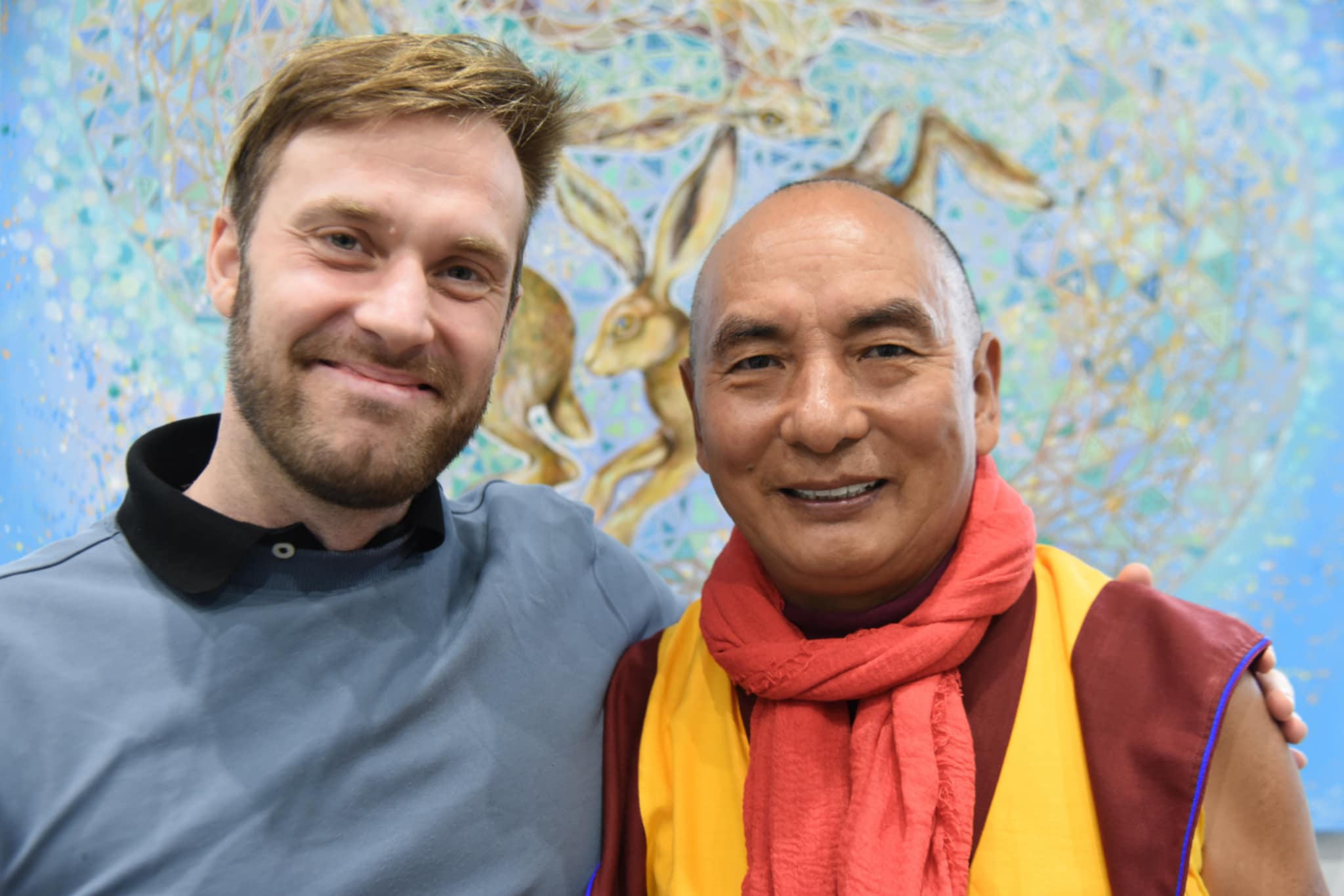
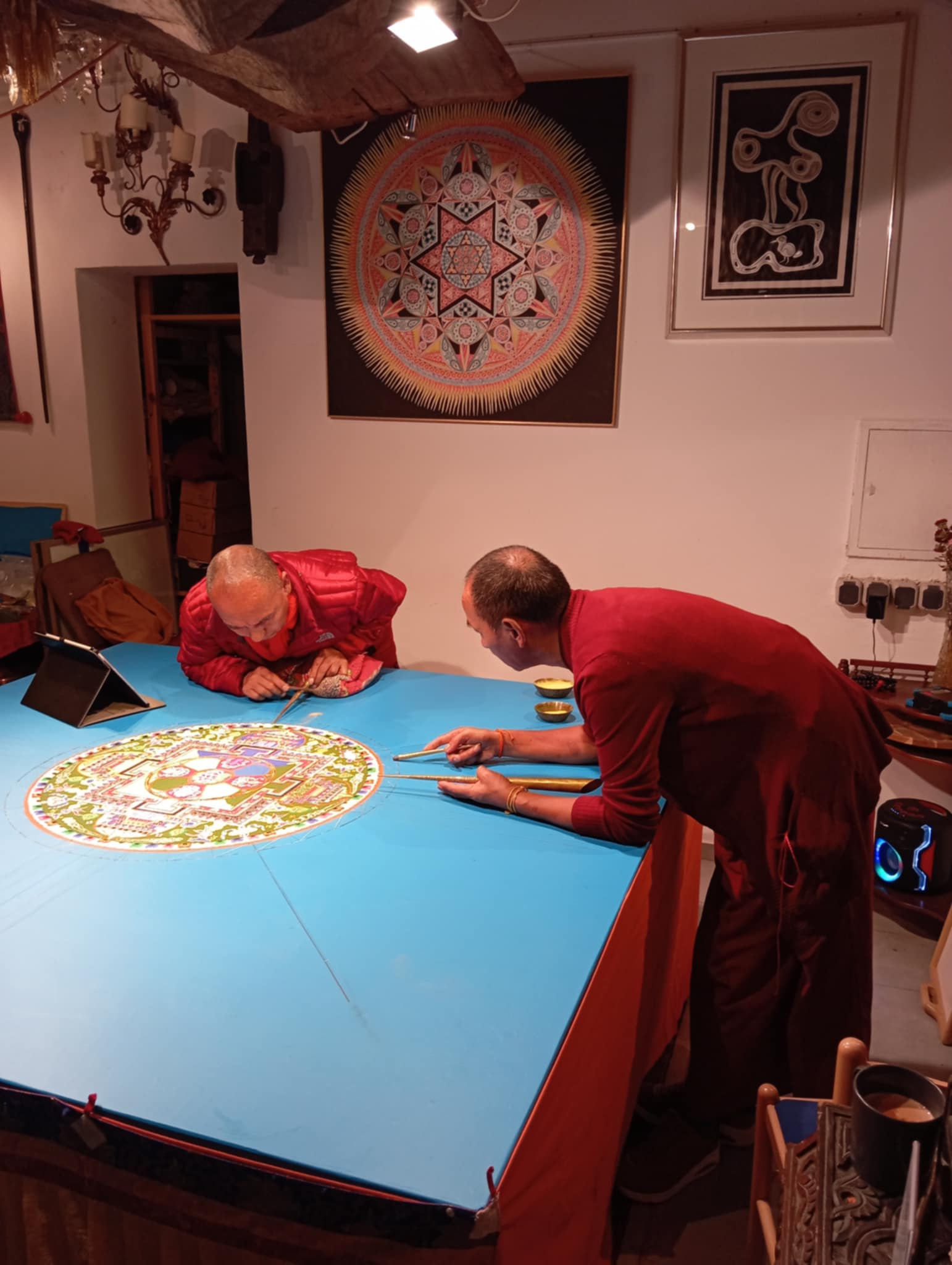
Tibetan Geshe Lobsang Soepa & Peace Researcher Josef Mühlbauer – what can peace studies learn from a Monk?

After the pūjā with Geshe Lobsang Soepa, peace researcher Josef Mühlbauer conducted an interview with the Geshe [highest title to monks] on the topic of peace.

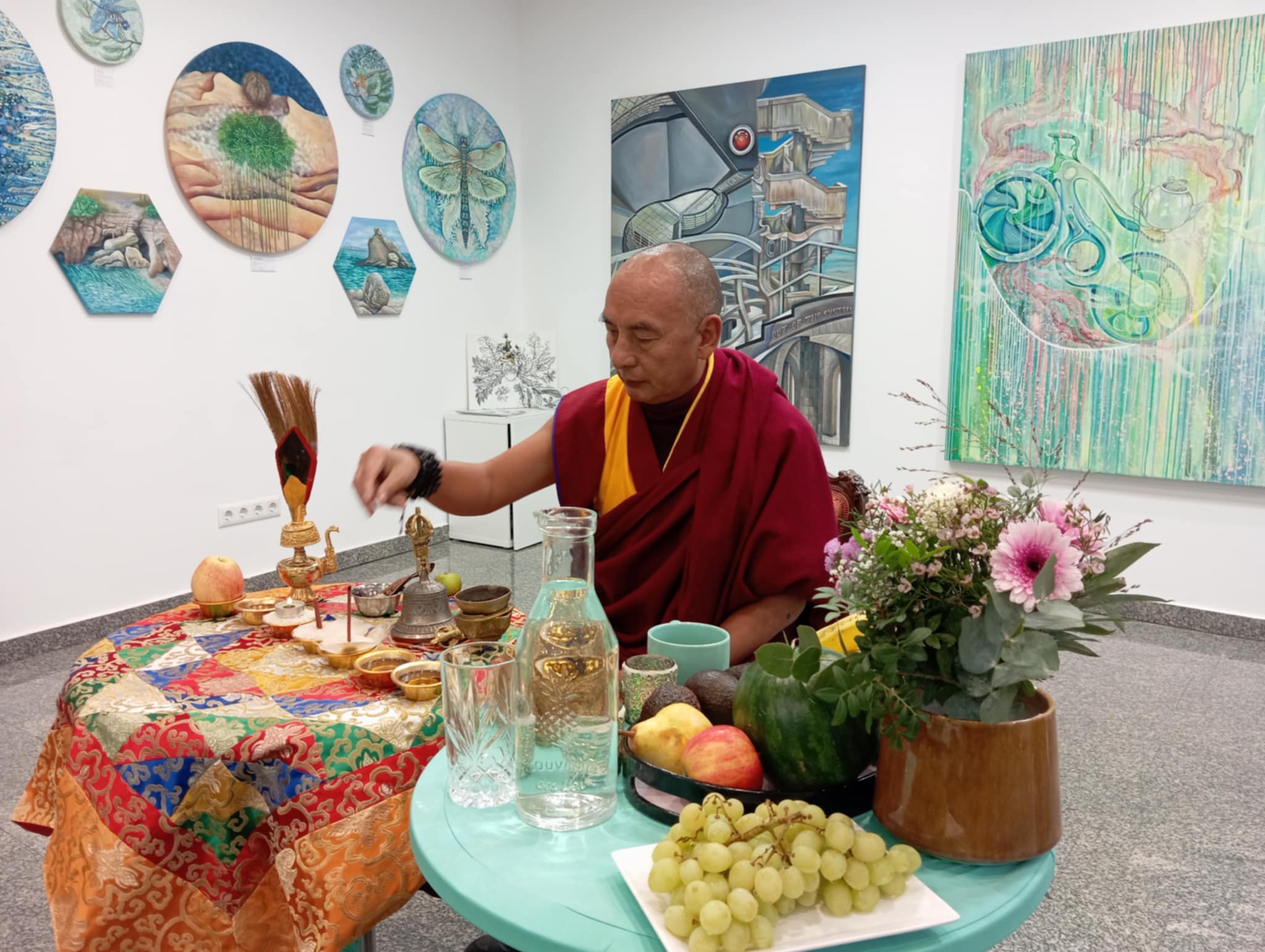
But first let me say few words on pūjā. In Tibetan Buddhism (as well as in Hinduism), a pūjā is a ritual act of offering, prayer, and devotion. It can include chanting, making offerings such as water, incense, flowers, or food, and reciting prayers or mantras. The purpose is to honor enlightened beings, accumulate merit, remove obstacles, and generate positive energy for oneself and others. In the Tibetan context, pūjās are often performed by monks or practitioners for healing, protection, or blessings. Here Geshe Lobsang Soepa did a pūjā in the beautiful Art Gallery Bella Volen.

The Tibetan monk – Geshe Lobsang Soepa, who went to visit many world leaders like for example Volodymyr Zelensky, explained in the interview with peace researcher Josef Mühlbauer that human beings are fundamentally interconnected and therefore inherently social. We must live, eat, drink, and walk together; otherwise, we remain isolated. He emphasized that, in order to achieve peace, we must address the root causes of conflict. Just as in medicine it would be misguided to treat only the symptoms rather than the underlying disease, so too in conflict resolution we must look beyond surface manifestations. He further remarked that humanity constitutes a single family, and our common home is the world. From this perspective, borders and nationalism can be understood as obstacles to uniting the human family. He stressed that our attention should be directed toward what is within our power to change. War and conflict are human-made social problems; therefore, they can be transformed. There is, he concluded, no such thing as a God-given or God-justified war.

The monk also created a sand mandala in Vienna, and of course I was curious about what we can learn from this practice in peace studies?

A sand mandala (from Sanskrit maṇḍala, “circle”) is an intricate geometric design made with colored sand, often depicting the dwelling place of a Buddhist deity or a cosmological map of the universe. Monks create it as a spiritual practice, not as “art” in the Western sense. The process is often accompanied by prayers, chanting, and meditation. The act of creating and dissolving the mandala is meant to generate compassion, healing, and balance, both for the participants and for the wider community. Sand Mandalas help students and practitioners reflect on how conflicts, like mandalas, are impermanent and subject to transformation. They highlight the process over the outcome. Peace building is not only about the final agreement but about the process of dialogue, trust-building, and patience. It can be seen as a metaphor in the sense that peace is often fragile and can be easily disrupted like the sand grains in the Sand Manadala. Just like the sand, peace requires careful arrangement. And the Sand Manadala is like the monk said in the interview with Peace Researcher Josef Mühlbauer, it is a symbol of geometry that symbolizes the interconnectedness of all beings. This is an insight that is crucial to understand systemic, epistemic and structural violence.

Geshe Lobsang Soepa is a Tibetan Buddhist monk, teacher and master of ritual arts. Born in the U-Tsang province of Tibet (near Lhasa); his birth name was Norsang. The name Lobsang Soepa was given by the 14th Dalai Lama. After facing political pressure and imprisonment under Chinese authorities for refusing to renounce monastic life, he escaped to India.

Josef Mühlbauer (born 1987) is an Austrian political scientist, peace researcher, journalist, and author. He works as a university assistant at the University of Graz, particularly in the field of Global Governance and Peace & Conflict Studies. His research interests include socio-ecological transformation, political theory, international relations, political education, and critical approaches to peace (e.g. critical peace studies).

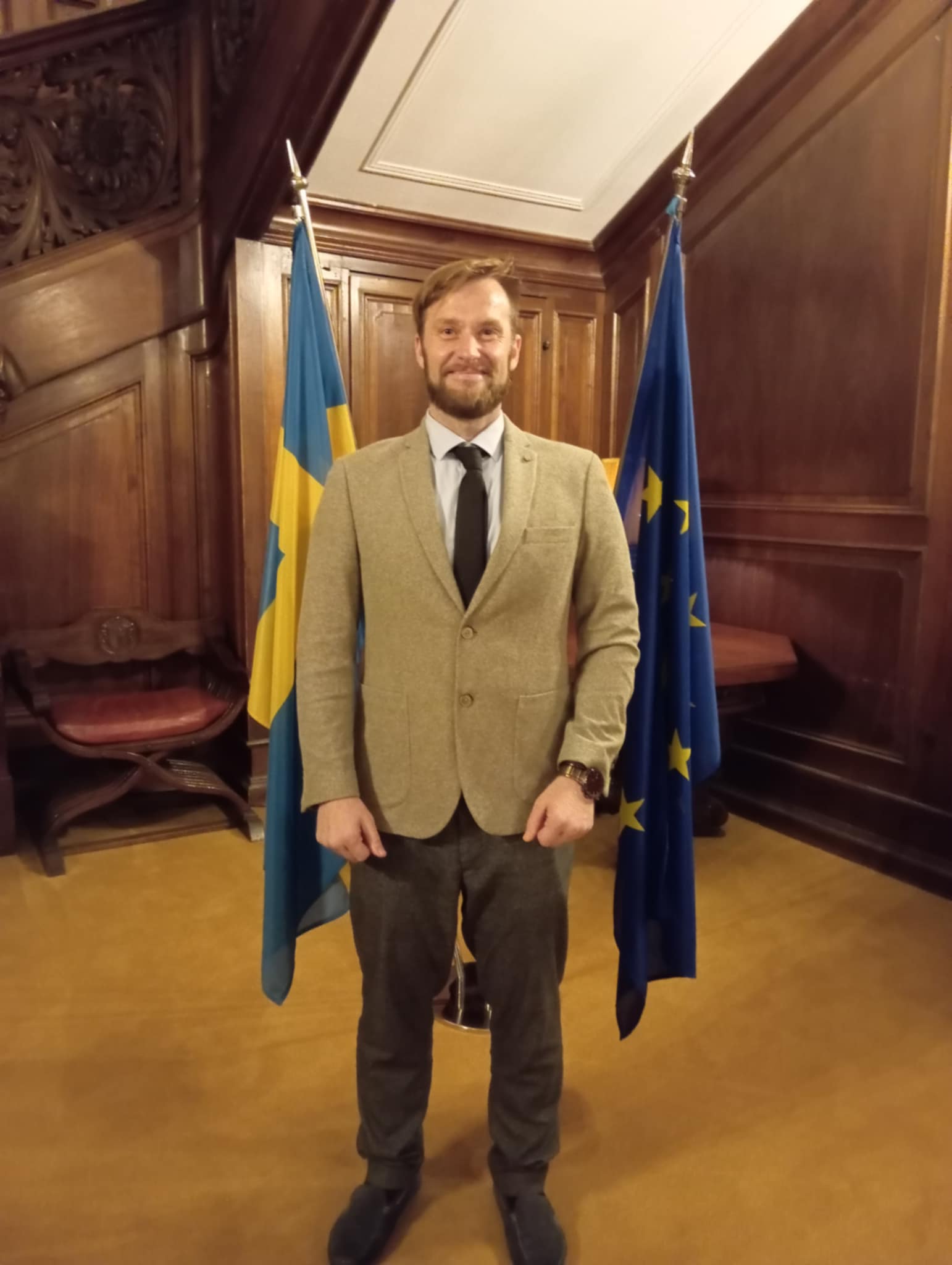
United Nations Security Council Resolution 1325 (UNSCR 1325) – at the Swedish Embassy in Vienna

Pathways to Peace: Legal Accountability and Feminist PeacebuildingPanel discussion on feminist peace and security policy

Glad to had the wonderful opportunity to be invited at the Swedish Embassy in Austria! – Short Report by Peace Researcher Josef Mühlbauer (University of Graz)

My Takewaways from the Panel Discussion on the UNSCR 1325:

The UNSC Resolution 1325 on Women, Peace, and Security isn’t a niche Issue, it’s a strategic imperative and a pathway to peace. Before UNSCR 1325, the work of women in peacebuilding was often informal, overlooked, and underfunded. The resolution, adopted unanimously in 2000, elevated women’s participation from a „nice-to-have“ to a mandatory component of international peace and security efforts. It provided a legal and political basis for advocates to hold governments and the UN itself accountable.

Milestone in Peace Building/ Peace Keeping & Peace Research: On October 31, 2000, the UN Security Council made history. For the first time, it recognized that war impacts women differently—and that women are not just victims, but powerful agents of peace. This was the birth of Resolution 1325 on Women, Peace, and Security (WPS).

Why is the UNSCR 1325 so important?

It is important because sustainable peace is only possible when women are equally included. Studies show that peace agreements are 35% more likely to last at least 15 years when women are involved in their creation. UNSCR 1325 isn’t just about fairness; it’s about effectiveness, it is about resiliant peace!

Key facts & milestones – Four Pillars of Peace

2000: UNSCR 1325 is adopted unanimously.

2009: The US becomes the first country to launch a National Action Plan (NAP) to implement the resolution.

2015: A Global Study on the implementation of UNSCR 1325 is published, highlighting both progress and critical gaps.

Today: Over 100 countries have adopted National Action Plans.

Pillar 1 Participation: It calls for increased representation and meaningful participation of women at all levels of decision-making, including in peace processes, conflict prevention, and post-conflict governance. This means women should be at the negotiating table, not just as observers but as mediators, negotiators, and signatories.

Pillar 2 Protection: It requires parties to conflict to take special measures to protect women and girls from gender-based violence, including rape and other forms of sexual abuse, in situations of armed conflict. This was a critical recognition of rape as a weapon of war.

Pillar 3 Prevention: It calls for integrating a gender perspective into conflict prevention efforts and early warning systems. This means understanding the different ways men and women experience and signal the onset of conflict.

Pillar 4 Relief and Recovery: It mandates the integration of a gender perspective into all humanitarian and post-conflict reconstruction programs. This ensures that the specific needs of women and girls (e.g., access to healthcare, education, and economic opportunities) are addressed in refugee camps, disarmament, demobilization, and reintegration (DDR) programs, and in rebuilding institutions.

Lets honor Sweden’s Pioneering Role 🇸🇪

Sweden has been a global leader in turning the principles of 1325 into action:

In 2014, Sweden became the first country in the world to officially adopt a feminist foreign policy, with the WPS agenda at its core.

The agenda is far from complete. As we face new conflicts and challenges, the principles of 1325 are more critical than ever. Just look at #Sudan#Gaza#Afghanistan ..

Lets honor the Speakers:

(c)Minitta Kandlbauer/VIDC, Swedish Embassy 10.9.2025

H.E. Annika Ben David, Sweden’s Ambassador to Austria and Slovakia as well as Sweden’s Permanent Representative to the United Nations in Vienna

H.E. Manizha Bakhtari, Ambassador and Permanent Representative Ambassador of Afghanistan in Vienna

Julia Prummer, Policy Advisor for the Austrian Foreign Minister, Federal Ministry for European and International Affairs

Jennifer Sarvary Bradford, Crime Prevention and Criminal Justice Officer, United Nations Office on Drugs and Crime

Dima Hussain, Legal Scholar, European University Institute in Florence and Centre for Religious Studies at the Central European University Vienna

Waruguru Gaitho, Gates Cambridge International Scholar of Law, Centre for Gender Studies at the University of Cambridge

Moderation: Miriam Mona Mukalazi, VIDC Global Dialogue

Critical Remarks on the UNSCR 1325:

There is unfortunately a gap between commitment/statements/declarations and the reality on the ground. While the norm is established, implementation is lagging. Women are still grossly underrepresented in formal peace processes. For example, between 1992 and 2019, women constituted only 13% of negotiators, 6% of mediators, and 6% of signatories in major peace processes. In conflicts from Ukraine to Sudan, Yemen, and the DRC, sexual violence continues to be used as a tactic of war, and women’s voices are often sidelined in humanitarian response and peace talks.

Author: Josef Mühlbauer BA BA MA (University Assistent at the University of Graz) is a peace researcher, published several books and peer reviewed academic articles, is a scientific researcher at Empowerment for Peace and the GSIS Institute. He is also the host of the Varna Peace YouTube Channel.

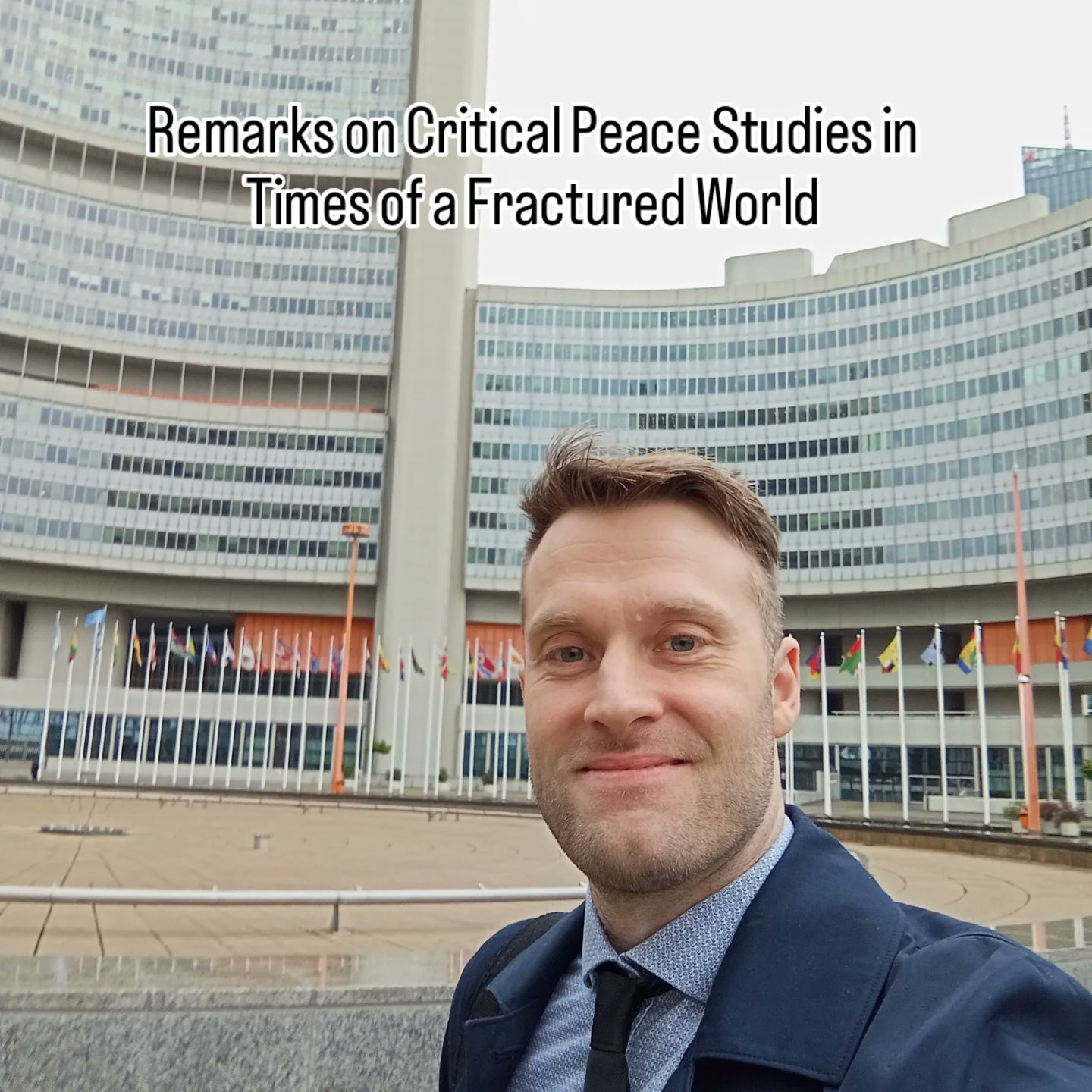
Peace in a Fractured World (Order) – Peace Researcher Josef Mühlbauer at the United Nations (Vienna International Center) Vienna

At the Vienna International Center (VIC) (the UN Body in Vienna, Austria), peace researcher and peace journalist Josef Mühlbauer from the University of Graz delivered an urgent appeal for peace and justice in his opening remarks to the UN NGO Committee on Peace. Speaking under the title “A Fractured World”, he reflected on the legacy of the United Nations as a cornerstone of diplomacy and human rights while warning of today’s crises. The Video reached in few months more than 7.000 views! That shows that the topic is still very important and matters to all of us!

Mühlbauer highlighted the devastating humanitarian situation in Gaza, calling it a test of the world’s commitment to the Universal Declaration of Human Rights. He also condemned the erosion of disarmament efforts, pointing to the reckless modernization of nuclear arsenals, while global resources are diverted away from fighting hunger, poverty, and climate change.

Central to his address was the role of Critical Peace Studies, which he framed around the revolutionary ideals of égalité, fraternité, and solidarité. He stressed that true peace is not merely the absence of war, but the presence of justice, inclusion, and equity. Drawing on examples from grassroots movements and nonviolent resistance, he argued that peace must be built through solidarity across borders and the dismantling of systems of oppression.

Closing his (emotional) speech, Mühlbauer urged the international community to reject the myth of inevitable violence and to invest in dialogue, justice, and the “messy but glorious work of peace.” His words stood as both a critique of current failures and a call to action for a more just and humane global order.

Josef Mühlbauer is the co-editor of several books, such as „Critical Peace Studies“ (Kritische Friedensforschung) (2024). He is a member of the Österreichischer Journalisten Club where he teaches for the certified course „Journalists4Peace“. Last but not least he is a University Assistant and Peace Researcher at the University of Graz in Austria.

For requests write here: josef.muehlbauer@uni-graz.at

Round Table „Für eine wehrhafte Demokratie frei von Gewalt – durch eine starke Friedens- und Konfliktforschung“

Round Table: Für eine wehrhafte Demokratie frei von Gewalt - durch eine starke Friedens- und Konfliktforschung. Josef Mühlbauer, eingeladen von Eva-Maria Holzleitner.
Panel-Josef-Mühlbauer-Friedensforscher-Beim-Round-Table-im-Bundesminsterium-Als-Experte-Friedensforscher-Friedensjournalist-Auf-Einladung-von-Eva-Maria-Holzleitner

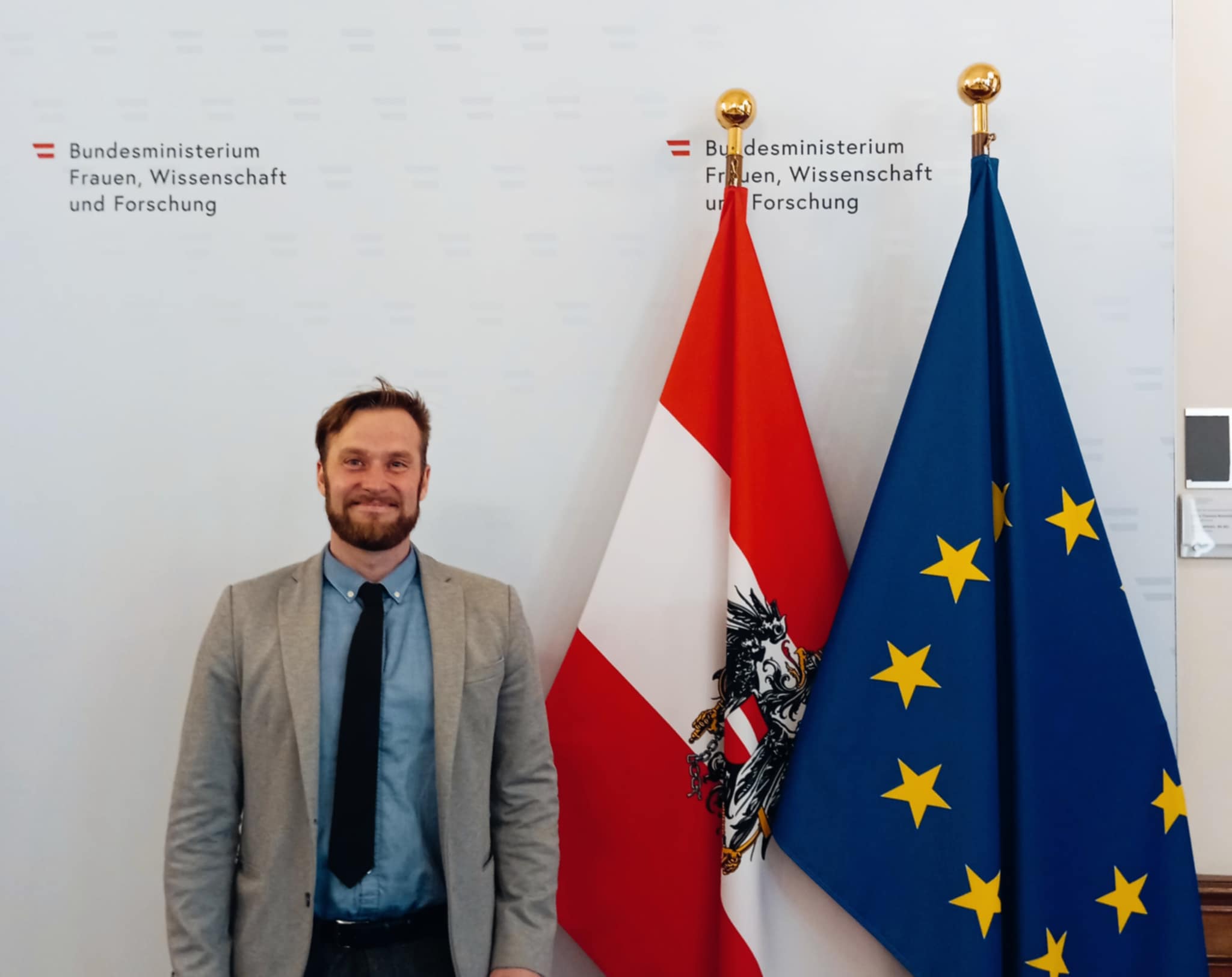
Die Bundesministerin für Frauen, Wissenschaft und Forschung der Republik Österreich – Eva-Maria Holzleitner (SPÖ) hat am Dienstag den 9. September 2025 Expert:innen aus der Wissenschaft eingeladen, insbesondere aus der Friedens- und Konfliktforschung. Bei diesem Round Table „Für eine wehrhafte Demokratie frei von Gewalt – durch eine starke Friedens- und Konfliktforschung“ hat die Ministerin Menschen aus den Bereichen Politik, Verwaltung, Zivilgesellschaft, Militär und Wissenschaft eingeladen, um die wichtigen Themen unserer Zeit zu besprechen.

Die Problemlage, bzw. der Ausgangspunkt war für die Ministerin die derzeitige Polykrise. „Weltweit geraten demokratische Systeme ins Wanken, Grundwerte werden infrage gestellt und Gewalttaten, insbesondere von Männern gegen Frauen, nehmen zu. Rechtsstaatlichkeit und Wissenschaftsfreiheit werden in Frage gestellt und Errungenschaften in Klimaschutz, Antirassismus und Gleichstellungspolitik ausgehöhlt. Gleichzeitig stellen Tech-Riesen die Welt vor unglaubliche Herausforderungen.“ (siehe Holzleitner vom 10.9.2025).

Nach der Begrüßung durch die Bundesministerin Eva-Maria Holzleitner, BSc ging es direkt zu den Panels. Im ersten Teil sprach die Friedensforscherin Assoc. Prof.in Claudia Brunner per Videobotschaft über die fehlende Institutionalisierung der Friedens- und Konfliktforschung im Verhältnis zu anderen Ländern wie etwa Deutschland. Vor Ort vertreten wurde sie von Dr. Viktorija Ratkovic (ebenfalls Universität Klagenfurt).

Panel-Josef-Mühlbauer-Friedensforscher-Beim-Round-Table-im-Bundesminsterium-Als-Experte-Friedensforscher-Friedensjournalist-Auf-Einladung-von-Eva-Maria-Holzleitner

Gleich im Anschluss daran sprach der Friedensforscher Josef Mühlbauer (Universität Graz) über die Rolle der Zivilgesellschaft und die Rolle der Wissenschaftsvermittlung von Friedens- und Konfliktforschung. Dabei wurden nicht nur die Prinzipien der Kommunikation – entlang des Friedensjournalismus (u.a. Johan Galtung; Steven Youngblood…) – sondern auch die verschiedenen Plattformen und Strategien der Wissenschaftskommunikation aufgezeigt. Hierbei wurden Formate wie etwa längere Podcasts/ Interviews auf YouTube, oder öffentliche Podiumsgespräche & Buchbesprechungen in der historischen Tradition der Salonkultur vorgestellt. Bei dieser Art der Wissenschaftsvermittlung geht es darum:

  • Dichotome Denkmuster – also „schwarz/weiß-Denken“ zu dekonstruieren;
  • Propaganda und ihre Wirkung aufzudecken;
  • Vorlauf & Kontext von Konflikten einer breiten Bevölkerung zu erläutern;
  • Soziale Gerechtigkeit & Demokratie zu stärken;
  • Frieden im Sinne Galtungs „positiv“ zu fassen – das heißt, Frieden nicht als die bloße Abwesenheit von Krieg zu verstehen.
  • Lokale Akteure, von Gewalt betroffene, Subalterne, Stimmen aus dem Globalen Süden und weibliche Akteurinnen zuzuhören – Ihre Bedürfnisse und Perspektiven ernst nehmen.
  • Wissenschaftliche Erkenntnisse einer breiten Bevölkerung zugänglicher machen („Übersetzungsarbeit“)
  • Menschen für die demokratischen Werte von „Freiheit, Brüderlichkeit/Geschwisterlichkeit und Solidarität“ sensibilisieren.

Aus der Perspektive eines Friedensforschers, war es für mich (Josef Mühlbauer) persönlich ein sehr lehrreicher Nachmittag & Abend in einem Raum des gegenseitigen Lernens, Zuhörens und Reflektierens.

Danach kam Helmut Leopold vom Austrian Institute of Technology zu Wort und analysierte, dass die EU bzw. Europa keinen Status der Autonomie im technologischen Sinne habe, weder was die Hardware (Mikrochips/ Halbleiter; Gallium; Germanium…) noch was die Software und Infrastruktur (Satelliten; Server; Star-Link; Social-Media…) betrifft. Damit macht sich ganz Europa abhängig von Einzelpersonen wie Elon Musk, bzw. von Transnationalen Konzernen die die Wertschöpfung und das Wissen ins Ausland bringen.

Die drei Kolleginnen aus der Universität Innsbruck haben im zweiten Teil des Round Tables die Perspektiven der Kriminalsoziologie (Schwerpunkt Extremismus), Psychologie (Schwerpunkt Resilienz) und die Bedeutung der politischen (historischen) Bildung hervorgehoben.

Bin dankbar für das Vertrauen und es ist mir eine besondere Ehre meine Expertise als Friedens- und Konfliktforscher teilen zu dürfen. Durfte an diesem Abend wundervolle Kolleg:innen, Politiker und Experten aus dem Militär kennenlernen.

Weltweit geraten demokratische Systeme ins Wanken, Grundwerte werden infrage gestellt und Gewalttaten, insbesondere von Männern gegen Frauen, nehmen zu. Rechtsstaatlichkeit und Wissenschaftsfreiheit werden in Frage gestellt und Errungenschaften in Klimaschutz, Antirassismus und Gleichstellungspolitik ausgehöhlt. Gleichzeitig stellen Tech-Riesen die Welt vor unglaubliche Herausforderungen.

Beim Round Table „Für eine wehrhafte Demokratie frei von Gewalt – durch eine starke Friedens- und Konfliktforschung“ habe ich Expert:innen aus der Wissenschaft eingeladen, um genau darüber zu reden und Ableitungen zu tätigen.

Jetzt gilt es, alles daranzusetzen, unsere demokratischen Prozesse und Strukturen sowie das Vertrauen in unsere Demokratie zu stärken – und zugleich die Kompetenzen in Friedens- und Konfliktforschung auszubauen. Denn es geht um unsere wehrhafte Demokratie. so Bundesministerin Eva-Maria Holzleitner.
Panel-Josef-Mühlbauer-Friedensforscher-Beim-Round-Table-im-Bundesminsterium-Als-Experte-Friedensforscher-Friedensjournalist-Auf-Einladung-von-Eva-Maria-Holzleitner

Bin vollkommen der Meinung unseren Bundesministerin Eva-Maria Holzleitner: „Jetzt gilt es, alles daranzusetzen, unsere demokratischen Prozesse und Strukturen sowie das Vertrauen in unsere Demokratie zu stärken – und zugleich die Kompetenzen in Friedens- und Konfliktforschung auszubauen. Denn es geht um unsere wehrhafte Demokratie.“ (10.9.2025). Abonniert einfach den Instagram Account der Bundesministerin um weitere Infos zu diesen und kommenden Events zu erhalten.

Panel-Josef-Mühlbauer-Friedensforscher-Beim-Round-Table-im-Bundesminsterium-Als-Experte-Friedensforscher-Friedensjournalist-Auf-Einladung-von-Eva-Maria-Holzleitner

So weit die ersten Einblicke aus dem Round Table zur Friedens- und Konfliktforschung.

Panel-Josef-Mühlbauer-Friedensforscher-Beim-Round-Table-im-Bundesminsterium-Als-Experte-Friedensforscher-Friedensjournalist-Auf-Einladung-von-Eva-Maria-Holzleitner

Panel Discussion on Panic & Worlds in Disorder – Peace Research & Peace Studies at The ARS Electronica Festival 2025

ARC Electronica Festical 2025, Panel Discussion on Worlds in Disorder with Peace Researcher Josef Mühlbauer

From a peace research perspective, our panel deconstructed the connections between geopolitics, the current global rise of right-wing extremism, and the legacy of the failed US-led intervention in Afghanistan. You can watch the whole event and the panel discussion on the YouTube Channel of ARS Electronica.

Panel Discussion Worlds in Disorder. With Josef Mühlbauer (Moderator), Stephanie Fenkart, Natascha Strobl & Emran Feroz at the ARS Electronica Festival 2025 in the Postcity Conference Hall in Linz.

We analyzed how the failure of the US-led invasion and intervention in Afghanistan (since 2001) exemplifies the fundamental flaws of liberal interventionism and the limits of imposed peace through military means (the so called „liberal Peacebuilding). This failure has not only created a humanitarian crisis but has also severely damaged the credibility of Western powers (and values), creating a power vacuum and accelerating a shift towards a more multipolar—and yet unstable—world order. Fenkart made the argument that the EU must step up, and realize its strategic autonomy.

The discussion critically examined how this geopolitical disillusionment and the narratives of „endless, futile wars“ are exploited by right-wing populist and extremist movements. These groups weaponize the legacy of intervention to fuel isolationism, xenophobia, and a rejection of multilateral institutions, thereby undermining the very frameworks designed to maintain international peace and security. Strobl pointed out that we wittness a global rise of fascism.

Ultimately, the panel argued that these are not isolated crises but symptoms of a deeper breakdown. We concluded that a sustainable path forward requires a critical peacebuilding approach: moving beyond militarized responses, addressing the root causes of conflict and radicalization (such as inequality and political disenfranchisement), and rebuilding trust through accountable diplomacy and support for inclusive civil societies.

The interaction with the audiance was vivid and showed the lively engagement of the audiance with the panelists.

Here you can find all the participants: https://ars.electronica.art/panic/en/view/worlds-in-disorder-understanding-times-of-political-change-and-uncertainty-23038ddb450c80988a7adb408ec1c7ed/

Visit the YouTube Channel of ARS Electronica: https://www.youtube.com/@arselectronica

Dust of Darfur – Deep (Seek) House Peace Song

Derzeit erleben wir weltweit über 50 bewaffnete Konflikte. Mindestens zwei davon zeigen uns gerade mit brutaler Deutlichkeit, was genozidale Kriegsführung wirklich bedeutet.

„Im Sudan, in der Region Darfur, breitet sich die Cholera explosionsartig aus. Die Zahlen sind erschütternd: Allein in einer Stadt, Tawila, sind seit Juni über 1.180 Menschen erkrankt, darunter 300 Kinder. Mindestens 20 sind bereits gestorben. Diese Seuche trifft auf eine Bevölkerung, die bereits am Limit ist: Gewalt, Hunger und eine völlig zusammengebrochene Gesundheitsversorgung. Die Zahl der mangelernährten Kinder hat sich im letzten Jahr verdoppelt – eine tödliche Kombination.“ (UNICEF, 2025)

„Und dann blicken wir nach Gaza. Laut einer Analyse im Guardian, die auf israelischen Militärdaten basiert, sind 83 Prozent der Getöteten Zivilisten – d.h Frauen, Kinder, Männer, die keine Kombattanten waren. Diese unvorstellbare Zahl ist die Grundlage für die Vorwürfe, dass es sich hier um einen Genozid handeln könnte.“ (Emma Graham Harrison & Yuval Abraham, Guardian 2025)

Diese beiden Krisen sind nur Beispiele von vielen. Sie erinnern uns daran, warum multilaterale Abkommen und die Arbeit der UN so unendlich wichtig sind. Für den Frieden. Für die Menschlichkeit.

Das Lied „Dust of Darfur“ ist ihnen gewidmet. Hört es euch gerne an und teilt es wenn ich auch gegen Krieg und gegen Genozide seid!

Hier ein weiterer Textbaustein der in den Lyrics als „fragmented world“ vorkommt. Hier die ganze Rede in der UN in Wien.

Critical Peace Analysis of Ukraine War Negotiations: Power, People, and Resources

Context of the „Peace Negotiations“ in Alaska (2025):
The prospect of peace negotiations (Alaska 2025) between the US, and Russia represents one of the most critical geopolitical junctures of the 21st century. Therefore it is important to understand the broader picture. The ongoing „peace negotiations“ between the US and Russia cannot be understood merely as a tactical chess game between great powers (realist school). We need to consider raw materials, the imperial mode of living (capistalist mode of production), and class struggle in order to see the bigger picture.

Great Power Bargaining? One Part of the Picture: (Neo-)Realism
Although there are no direct and official peace negotiations between the US/Russia and Ukraine, there are signals from the great powers that suggest a preparation for potential „back-channel talks“. Trump has repeatedly claimed he would end the Ukraine war in only „24 hours“, implying a willingness from the US to pressure Ukraine into concessions, most likely involving the (de facto not de jure!) recognition of Russian control over Crimea and the annexed territories (like the Donbas) in exchange for a ceasefire and peace deal. Peace in that regard comes with a price tag. This approach aligns with a (neo-)Realist school of thought, most famously articulated by Prof. John Mearsheimer, which analyzes this war as a great power proxy conflict. Ukraine in that sense is seen as the „backyard“ of Russia. In other words, Ukraine is in the sphere of influence of Russia. From this (neo-)Realist perspective, NATO’s eastward expansion encroached on Russia’s sphere of influence, provoking a predictable and brutal response. The great power bargaining, or the Realist negotiation, would therefore involve:

  • Neutrality of Ukraine
  • Recognizing Russia’s regional security interests
  • No NATO expansion to the east, near the Russian border.

The Bigger Picture Contains Class Struggle & Raw Materials: Critical Peace Studies
While valuable, this theoretical framework overlooks other key dimensions (Denys Pilash 20.08.2025, Democracy Now).
It is overwhelmingly working-class men—both Ukrainian and Russian—who are dying on the frontlines. The war reproduces social inequalities where elites decide, and ordinary citizens pay the price. Ukraine is rich in critical raw materials such as lithium, titanium, and rare earths. These resources are central to the global competition over energy transition, technology, and future economic power (see also the Critical Raw Material Act, 2023). Both the US/EU and Russia have vital interests in securing or denying access to them. Thus, the war is not only about borders or NATO but also about the material basis of 21st-century industrial strategy. The current imperial mode of living contains a mode of production that is heavily dependent on critical raw materials and the exploitation of cheap labor force. In that sense, critical peace scholars highlight that in order to make a lasting peace deal one needs to create more just ways of living. Before I dig deeper into that approach, my take on the Alaska „peace talks“.

My Take on the Alaska Meeting:
In 1784, Grigorii Shelikhov established the first permanent Russian outpost on Kodiak Island at Three Saints Bay (Russian Colonization of Alaska). Eager to eliminate rival Russian companies and gain control of the entire North Pacific fur trade, Shelikhov expanded the sphere of Russian influence along the Alaskan coast and petitioned Empress Catherine the Great to grant him a monopoly (full essay). Alaska was Russian America until its purchase by the United States in 1867, therefore Alaksa can be seen as a source of Putins imperial nostalgia. For Russia (under the Tsar), it was a distant, difficult-to-defend territory that became a financial liability. For the emerging US, it was a strategic masterstroke, adding immense natural resources and extending its Pacific power projection. Its importance today is not territorial but diplomatic and symbolic. It stands as the prime example of a peaceful, large-scale territorial transaction between the two powers. It represents a time when US and Russian interests, despite mutual suspicion, could be reconciled through pragmatic negotiation. On the other hand, it shows the imperialist behaviour of Tsarist Russia and the US. On the surface, it was a peaceful and pragmatic deal, but beneath that, it was a fight for hegemony and expanding its sphere of influence. Therefore Alaksa means inner-imperialist negotiations, or great power chess games. For both, Putin and Trump, this is of course the right place to talk.

Many analysts portray Donald Trump’s accommodating stance toward Putin as born of personal admiration or even susceptibility (Michael Clarke 20.08.2025, Skye News). A more compelling, strategic explanation is that it stems not from a fear of Putin the person, but from a prudent and acute fear of the logical endpoint of uncontrolled escalation: a direct NATO-Russia war or nuclear exchange. This is not weakness; it is a form of realist caution. The fundamental principle of Mutually Assured Destruction (MAD) that governed the Cold War still applies.

Pathways to a Lasting and Just Peace: Critical Realism
Maybe Prof. Mearsheimer is correct. In the short to medium term, stability will require a realist bargain between the superpowers. Security guarantees for Ukraine would involve states from the global south, and from Europe to ensure the sovereignty of Ukraine within its agreed borders. Security guarantees for Russia would involve negotiations on NATO expansion and the limits on missile deployments. Treaties like START, INF, and Open Skies should be implemented again. Security for European powers would involve the reduction of energy and military dependence on both the US and Russia, granting Europe more strategic autonomy.

From a critical peace and critical realist stance, these described guarantees will only freeze the conflict. Long-term, resilient peace should address the root causes. This means supporting Ukrainian and Russian anti-war and pro-democracy movements. Only peace negotiations from below have more legitimacy. Elites can easily mobilize a poor or indoctrinated population for war; therefore, the reduction of the grotesque inequality within and between states should be the top priority of governments. Last but not least, local voices should be heard from all sides of the war. Economic, political, and cultural ties across the region should be created. Besides „Realpolitik“, we need to understand peace negotiation not as a single decision by rich and powerful (old, white) men, but as a complex process that includes the war’s material basis (resource competition, capitalism) and its „human cost“ borne by the working class.

Of course, this is not the full picture, but hopefully, it is a bigger one than that portrayed by the Realist school of thought or by liberal thinkers.

Josef Mühlbauer, Author of several books and scienfitic articles, (Keynote) Speaker, Peace Journalist at the Varna Institute for Peace (VIPR), Peace Researcher at the University of Graz in the field of Critical Peace Studies. Member and scientific researcher at the NGO „Empowerment for Peace“ (EfP).

Josef Mühlbauer, Author, Speaker, Peace Journalist, Peace Researcher at the University of Graz in the field of Critical Peace Studies
Friedensjournalist, Frieden, Friedensforscher, Friedenswissenschaft, Friedensbuchautor, Josef Mühlbauer, Speaker und Autor (Foto: Uni Graz/Radlinger 2025)

Conference Report: Second International Conference on Critical Peace Studies

2nd International Conference on Critical Peace Studies – 6th August 2025, Pakistan – Report by Josef Mühlbauer

The 2nd International Conference on Critical Peace Studies provided a vital platform for rigorous scholarly engagement with pressing global conflicts and the structures perpetuating violence. The final announcement underscored the urgency felt by participants, particularly highlighting the ongoing crisis in Gaza as a backdrop demanding critical reflection and action. Keynote presentations offered profound theoretical and practical insights into pathways toward transformative peace.

he 2nd International Conference on Critical Peace Studies provided a vital platform for rigorous scholarly engagement with pressing global conflicts and the structures perpetuating violence. The final announcement underscored the urgency felt by participants, particularly highlighting the ongoing crisis in Gaza as a backdrop demanding critical reflection and action. Keynote presentations offered profound theoretical and practical insights into pathways toward transformative peace.

Highlights – Decolonizing Knowledge, Power and Being

Prof. Richard Jackson delivered a powerful and urgent address, invoking Walter Mignolo’s concept of „Epistemic Disobedience.“ He argued that the current era, marked by the „live-stream genocide in Gaza,“ necessitates a radical break from dominant, often Western-centric, knowledge systems that normalize or obscure such violence. Jackson passionately advocated for the creation and centering of indigenous knowledge as an act of resistance and a fundamental step towards building genuine peace. He framed epistemic disobedience as an essential scholarly and ethical imperative in times of overwhelming state violence and propaganda.

Prof. Huma Baqai provided a compelling analysis of contemporary shifting geopolitical alliances and realignment. She critiqued the common framing of the emerging world order as „multipolar,“ arguing that this term evokes the dangerous rivalries and bloc politics that characterized the era leading up to and including the First World War. Instead, Baqai strongly advocated for the concept of „Multiplexity.“ She defined this as a global system characterized by:

–> Multidimensionality: Complex interactions across multiple axes (economic, cultural, technological, security) beyond simple power poles.
Baqai argued that embracing multiplexity, rather than multipolarity, offers a more accurate and hopeful framework for navigating current global complexities and fostering cooperative stability.

–> The Absence of Hegemony: No single power or bloc dominating.

–> Decentralization: A more distributed and networked international structure.

Dr. Ahmad Waqas Waheed presented his significant work, „The Myth of Decolonization and the Global South.“ His presentation critically examined the persistent structures of power, knowledge, and economic dependency that continue to shape North-South relations long after formal colonial independence. He challenged the notion that decolonization is a completed project, arguing instead for a deeper understanding of its unfinished nature and the enduring challenges faced by the Global South within the contemporary international system.

The conference featured a rich tapestry of presentations beyond the keynotes. Numerous scholars, activists, and practitioners presented cutting-edge research and critical analyses on diverse themes, including:

  • Postcolonial and Decolonial Approaches to Peace & Conflict: Exploring the enduring legacies of colonialism and imperialism in contemporary conflicts and peacebuilding paradigms. Dr. Caroline Schöpf explored the machanisms of interellectal imperialims & academic dependency as well as the possibility of autonomous knowledge.
  • Intersectionality in Peace & Security: Examining how gender, race, class, religion, and other identities shape experiences of conflict and peace.
  • Critical Security Studies: Questioning traditional state-centric security models and exploring alternative conceptions of human and ecological security.
  • Peace Education & Pedagogy: Discussing innovative and critical methods for teaching peace and challenging structures of violence within educational systems.
  • Non-Western & Indigenous Peace Traditions: Highlighting diverse philosophies and practices of peacebuilding from often marginalized perspectives.
  • The Political Economy of Conflict: Analyzing the role of resources, economic systems, and global capitalism in driving and sustaining violence.

The depth and breadth of these presentations, spanning various disciplines and geographical contexts, significantly enriched the conference dialogue and underscored the multifaceted nature of critical peace studies.

Personal Reflection & Key Takeaways

Attending this Second International Conference on Critical Peace Studies was an exceptionally enriching experience. The intellectual rigor, the courageous engagement with contemporary atrocities like the situation in Gaza, and the profound theoretical contributions – particularly the emphasis on epistemic disobedience (Jackson), multiplexity (Baqai), and the critique of decolonization myths (Waheed) – provided invaluable insights and frameworks for understanding and challenging the root causes of violence and injustice in our world. The conference not only deepened my theoretical understanding but also reinforced the crucial role critical scholarship plays in advocating for a more just and peaceful future. I learned a tremendous amount from the diverse perspectives shared and the passionate commitment of all participants. Specifically, the conference significantly deepened my understanding in several critical areas:

The Necessity of Normative Scholarship for the Subaltern: Moving beyond detached objectivity, the conference validated the importance of engaged, normative scholarship. It powerfully demonstrated that researching and writing for and alongside the subaltern – centering their experiences, perspectives, and struggles – is not just acceptable but essential and good. This normative commitment is key to dismantling oppressive structures and amplifying marginalized voices in the pursuit of justice and peace.

The Strategic Imperative of South-South Cooperation: Presentations and discussions illuminated the vital role of South-South cooperation as a practical mechanism for challenging dominant power structures and fostering alternative pathways to development, security, and knowledge exchange outside traditional Western-centric frameworks. This emerged as a crucial strategy for building resilience and agency within the Global South.

Epistemic Liberation: Free & Non-Western Knowledge Production: Prof. Jackson’s powerful call for „epistemic disobedience“ resonated profoundly, underscoring the urgent need to break free from hegemonic knowledge systems. The conference strongly reinforced the critical importance of free, non-Western knowledge production, particularly the validation, creation, and centering of Indigenous knowledge. This is not merely an academic exercise but a fundamental act of resistance and a prerequisite for genuine peace and understanding.